
CaRbohydrate awaReness duRing the Racing season.
Carbohydrate awareness during the racing season
I hope this article will help you to get strong, energized and race with a full tank through the racing season!
By Andrea Henkel Burke
It´s racing season and fuel is critical for your performance. You may not feel if your fuel tank is low at the beginning of the season, but when the races start adding up, you will notice a decrease in performance if you're not keeping up. As soon as you sense being a little depleted, it will take some time to get back on track. That´s why it´s important to be aware of the topic and to monitor your storage levels.

When I was racing, we not only had one race a weekend, but three, and most of the time we
also raced for three weeks in a row. When you race 9 times in 18 days multiple times throughout the season, fueling becomes even more critical. Most people can make it through the first week but many struggle in weeks two and three.
The most important part for maintaining fitness in a schedule like this is having a good training foundation, which you set up during your training sessions in pre-season! But you can only do so much with solid training and at some point, nutrition also plays a significant role.
Nutrition is too big of a topic to cover in this article, so today we will focus solely on carbohydrates!
Carbs are the fuel of choice for high exertion activities, so naturally, XC-ski racing requires a lot of carbohydrates! Do you know what also needs carbs to function properly? It´s your heart and your brain. As a former biathlete, I had to make sure that I had an adequate cognitive function at the last shooting stage so that I could have the best chance of hitting all of my targets. But even without shooting, you also need to have the ability to outsprint your competitors at the finish line. Sprinting was never my strong point, so I needed every advantage possible with proper fueling to use my few fast twitch muscles.
"Carbo Loading" is more a less a thing of the past as we now know that your carbohydrate storage is limited. Depending on your size and muscle mass, you can store between 1200 – 1800 calories in carbs. (1g carbs = 4.1 cal) Those storages are in your muscles and your liver. When eating carbohydrates, once your carbo storages are filled up, the rest is stored as fat. This is another excellent reason not to carbo load! And here are some more numbers. When racing, you might burn up to 1000 carb calories in an hour, but during this time your body could only intake around 1g carb/1kg body weight in an hour without getting cramps or digestive issues. If you took more then that, your intestines would suck water out of your cells to digest those extra carbs. This fluid loss would cause your cells to function in a sub-optimal way, ultimately hurting your performance. This is especially important to consider when doing super long distance races!
The most important part for maintaining fitness in a schedule like this is having a good training foundation, which you set up during your training sessions in pre-season! But you can only do so much with solid training and at some point, nutrition also plays a significant role.
Nutrition is too big of a topic to cover in this article, so today we will focus solely on carbohydrates!
Carbs are the fuel of choice for high exertion activities, so naturally, XC-ski racing requires a lot of carbohydrates! Do you know what also needs carbs to function properly? It´s your heart and your brain. As a former biathlete, I had to make sure that I had an adequate cognitive function at the last shooting stage so that I could have the best chance of hitting all of my targets. But even without shooting, you also need to have the ability to outsprint your competitors at the finish line. Sprinting was never my strong point, so I needed every advantage possible with proper fueling to use my few fast twitch muscles.
"Carbo Loading" is more a less a thing of the past as we now know that your carbohydrate storage is limited. Depending on your size and muscle mass, you can store between 1200 – 1800 calories in carbs. (1g carbs = 4.1 cal) Those storages are in your muscles and your liver. When eating carbohydrates, once your carbo storages are filled up, the rest is stored as fat. This is another excellent reason not to carbo load! And here are some more numbers. When racing, you might burn up to 1000 carb calories in an hour, but during this time your body could only intake around 1g carb/1kg body weight in an hour without getting cramps or digestive issues. If you took more then that, your intestines would suck water out of your cells to digest those extra carbs. This fluid loss would cause your cells to function in a sub-optimal way, ultimately hurting your performance. This is especially important to consider when doing super long distance races!
For example: Someone weighs 85kg, he could intake 85g carbs/h = 348 carb calories.
However, when you are not racing or exercising, your body is able to digest over 350 calories of carbohydrates in an hour. Now that we know how much we can store and consume let's look at a typical race day and do some math!
Full storage: let's assume 1500 calories (200 of which are stored in the liver. And the liver won't share these carbs for high performance. They are saved for survival)!
You warm up 20min (around 100 cal), race 45min (approximately 700 cal) and cool down (about 100 cal). So now you have burned 900 cal of carbohydrate, leaving yourself with less than half a tank! You might still feel all right because there is something left in storage and our body does not have the fancy tank fuel information that our cars have. We only differentiate if there is some energy left or if we are close to empty. But if you are not filling up your body correctly now after the first race, the second half of your race the next day will leave you with an unwanted surprise!
To understand this a little bit better, I want
However, when you are not racing or exercising, your body is able to digest over 350 calories of carbohydrates in an hour. Now that we know how much we can store and consume let's look at a typical race day and do some math!
Full storage: let's assume 1500 calories (200 of which are stored in the liver. And the liver won't share these carbs for high performance. They are saved for survival)!
You warm up 20min (around 100 cal), race 45min (approximately 700 cal) and cool down (about 100 cal). So now you have burned 900 cal of carbohydrate, leaving yourself with less than half a tank! You might still feel all right because there is something left in storage and our body does not have the fancy tank fuel information that our cars have. We only differentiate if there is some energy left or if we are close to empty. But if you are not filling up your body correctly now after the first race, the second half of your race the next day will leave you with an unwanted surprise!
To understand this a little bit better, I want
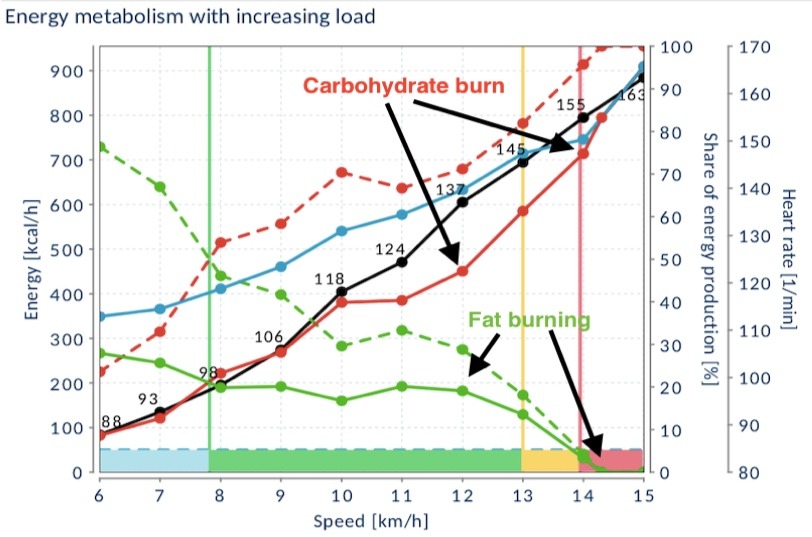
to show you an Aeroscan® test protocol. The test analyzes a lot of things, but for
now, we will just focus on how many calories of carbs and fat I burn at a specified speed and heart rates while running.
You can see that the faster I run (higher exertion), the more carbohydrates I burn. On the left side, you see the calorie numbers. I don´t burn as much in total, because I´m also only 5´2” and weigh under 110 pounds, but you get the idea.
Now you have some carbohydrate numbers you can play around with while mixing your pre and post race drinks, as well as planning your meals.
Now you have some carbohydrate numbers you can play around with while mixing your pre and post race drinks, as well as planning your meals.
I hope this article will help you to get strong, energized and race with a full tank through the racing season!