
Gaining muscle – what happens inside?
By Sarah Willis PhD.
We all understand by now that resistance training is a valuable part of a periodized training program. NTS does a wonderful job at showcasing a variety of exercises and working them successfully into a skiers training plan. So, let’s jump into this further – why exactly do we need to do resistance (strength) training?
One of the main purposes of resistance training is to stimulate muscle protein synthesis. When we train and perform any physical activity, we have muscle protein breakdown. Our bodies are then stimulated to regenerate and re-build with a process called muscle protein synthesis. To gain strength and build muscle, it is required to have more muscle protein synthesis than muscle protein breakdown. We need a positive net balance with more synthesis than breakdown, and this is not just one moment, but several cumulative periods (requiring intention and focus).
We stimulate muscle protein synthesis in 2 ways; resistance training and protein consumption (the building blocks for our body, amino acids; great examples of food with high protein content include: eggs, oatmeal, cottage cheese, chicken, black, beans, tuna, tofu, turkey, Greek yogurt, lentils, milk, quinoa, chickpeas, almonds, parmesan cheese, salmon). In a general statement, incorporating lean meats, lentils and beans, along with nuts are great choices for getting extra protein in your diet (especially within the 30-minute window after any training session) to re-build and promote muscle protein synthesis.
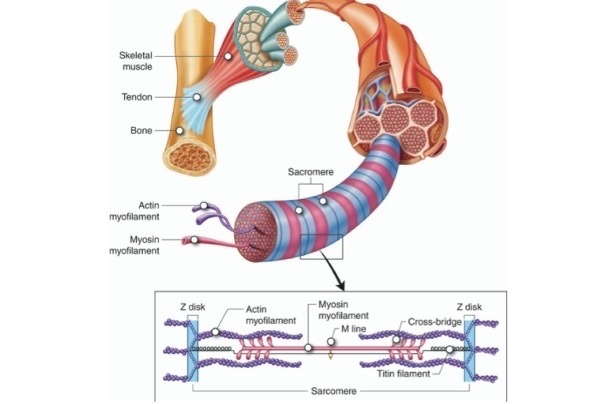
Factors of resistance training that are important include muscle tension, metabolic stress, and muscle damage. Before we get further into those, let’s first review our muscle physiology. Check out the image below to visualize this in our bodies. Muscles are connected to bones via the tendons, skeletal muscle is comprised of bundles (fascicles) of muscle fibers, inside the muscle fiber we have myofibrils (contractile structures) which are made up of many sarcomeres (smallest functional contractile unit of muscle) with which the arrangement of sarcomeres gives muscle it’s striated appearance.
If we were to ask about how the muscle actually grows, then there are other deeper hormones and factors involved which include anabolic pathways – growth through anabolism (energy and construction of molecules from smaller units), stimulation of growth factors from our pituitary gland (such as testosterone, glucocorticoids, etc.), stimulation of the thyroid hormone for metabolism regulation, and insulin-like growth factor (IGF-1) for promoting natural growth of bones and tissues. We need resistance training, together with balances of proteins, functional amino acids, carbohydrates, and optimal hormones levels to generate muscle hypertrophy (muscle growth).
Development of muscle through hypertrophy can take place with the stimulus of resistance training by adjusting several variables. Specifically, intensity, volume, exercise order, number of repetitions and number of sets, tempo of movement, and the time of rest periods between sets and exercises along with training status. The American College of Sports Medicine (ACSM) has general recommendations for strength/resistance training which state for a novice 1-3 sets per exercise, 8-12 reps (at 70-85% 1RM); advanced = 3-6 sets of 1-12 reps at 70-100% 1RM. 1 RM is a repetition maximum, workload related to a maximal one-time lift. If you haven’t performed this test, you could give a guesstimate of the workload based on perceived effort. More recently, the research literature in resistance training field has widened the ranges for achieving muscle hypertrophy adaptations.
Researchers have found that low-load (30-60% 1RM) exercise to volitional fatigue can provide similar benefits to high-loads (> 60% 1RM), however, it is important to reach volitional fatigue. Further, research has indicated that if you are not going to volitional fatigue, it is best to have most sets with a 3-4 rep reserve with still a moderate-to-high workload. In general, training volume of resistance training is composed of reps + sets + load, and these are the parameters to adjust for maximizing adaptation to increase training volume. Furthermore, it seems that resistance training performed to volitional fatigue (or close 3-4 reps reserve with mod-high loads) is very important and the training load itself matters less.
Earlier in this article, I mentioned that there are 3 major conventional factors for muscle hypertrophy = mechanical tension, metabolic stress, muscle damage. If we investigate the first couple, we can understand more about developing training programs. Muscle tension is created with high-load (> 85% 1RM) with low reps (1-5) and long rest (3-5min). This leads to large strength gains; however, muscle hypertrophy is compromised. Moreover, increased time in muscle tension leads to high neural recruitment which is a good thing as it helps us produce more fast-twitch fibers. Metabolic stress is a dose-response factor related to the volume of resistance training. High training volume can be characterized as 28-30 sets/muscle/week, which is more beneficial for hypertrophic adaptation than lower volumes around 6-10 sets/muscle/week. It is very interesting then to think about training with moderate reps (6-12), multiple sets (3-6), moderate load (60-80% 1RM), and short rest between sets (60 s), as this will increase metabolic stress (no need for high load to have hypertrophy, cool!). The take-away piece from increasing metabolic stress for me is related to the short rest time between sets 😊
If we think of traditional concentric training (muscle shortens under load), the hypertrophy builds more sarcomeres in parallel (greater pennation angle, no change in fascicle length). While primarily training eccentric (muscle lengthens under load) develops more sarcomeres in series (greater fascicle length, and small increase in pennation angle). Eccentric training allows the muscle to be under tension for longer time periods but requires more spotters and inter-set recovery time which extends the time needed for each session.
The more advanced an athlete is with resistance training, then there can be other techniques and methods introduced [such as supersets, drop sets, sarcoplasm stimulating training (SST), cluster sets, and low-load with blood flow restriction (BFR)]. Let’s briefly discuss some of these techniques.
Supersets are when training the same muscle group with several exercises. Performing multi-exercise efforts alternating between agonist (use of main muscle contracting to move joint, i.e., biceps) and antagonist (opposite action of another muscle, to return to original position or slow movement, i.e., triceps). These supersets can also be alternating upper- and lower-body each set. This is a time efficient training method.
Drop sets are a series of sets where you push to volitional fatigue, then perform the next set by lowering the load by 20% until volitional fatigue. These serve to increase metabolic stress, with high number of reps with short inter-set recovery. They are effective (especially for less trained individuals); however, benefits were similar to traditional resistance training when matching the training volume in well-trained individuals.
Sarcoplasm stimulating training (SST) is a newer method which involves a set of exercise at 70-80% 1RM until volitional fatigue with a short 20 second rest afterwards, followed by decreased load by 20% with a tempo of 4/0/1/0 (eccentric-lower weight, pause, lift weight, pause) with another 20 second rest, and repeat again with 2-3 decreased load sets. The 4/0/1/0 tempo exaggerates the eccentric phase while this exercise plan is more time-efficient than traditional resistance training. Another way to facilitate the SST could be with a load of 70-80% 1RM with rest lasting 45, next set 30, then 15, 5, 5, 15, 30, 45 seconds (no change in load). The purpose of the SST is to have high metabolic stress which has been shown to result in high muscle thickness, even with lower training volume than traditional resistance training.
Cluster sets are also common to promote muscle hypertrophy over time, with the intention to have shorter 20-60 seconds of inter-set rest with a lower number of reps. This decreases metabolic stress but increases the time under tension. Though these cluster sets are usually performed in parallel with periodized training programs, the question would be what if it was changed to shorter inter-set recovery with high volume and high load? This could also be a time-effective method.
Low-load resistance training with blood flow restriction (BFR) is another newer method where the most effective sequence according to researchers would be 30 reps, followed by 15, 15, and 15 with 30 seconds of rest between sets. This is performed with a light-load of 20-40% 1RM with 40-80% total occlusion pressure (my personal expertise would suggest 40-50% of total occlusion pressure). An important note here is that muscle growth occurs on the limb muscles only.
To conclude, drop sets, SST, and low-load with BFR are all training methods that increase metabolic stress. In general, it could be recommended to periodize training with 3-6 sets, 6-12 reps, 60 seconds (or less) rest, with a load of 60-80% 1RM (totaling 12-28 sets/muscle/week). When advancing training, using supersets to alternate between agonist-antagonist, and/or upper-lower body; drop sets, SST, or cluster sets could be of beneficial interest. The changes that are expected are as follows: after 4 sessions the cells become swollen, after 8-12 sessions are the main strength gains along with neural adaptations, following 6-10 weeks will result in beneficial muscle growth.
This is quite motivating for me, what about you? Let’s get to it!