
Training Tips for the Erg
By Ned Dowling,
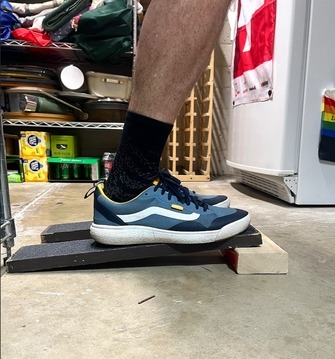
The incline also helps with moderating and supporting heel lift during the retrieval phase. The amount of heel raise during double poling is going to vary based on terrain and intensity–generally higher with sprinting and lower with endurance. With the majority of training volume being performed at lower intensities, the heels should be staying low the majority of the time. I found that standing on the ramp makes this more intuitive, and I’m able to better control that aspect of the retrieval phase. Then with sprinting where the heels are lifting a fair amount, I’ve found the ramp helps keep the hips forward and controls the tendency to over-extend the knees and hips.
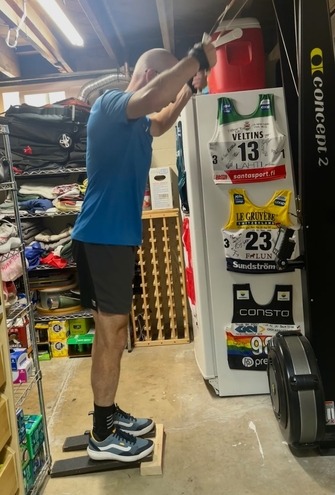
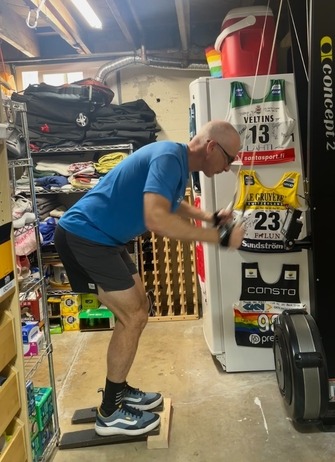
Stationary, double pole trainers (Concept2, Abilica, Ercolina, etc) are great but, not perfect, alternatives to rollerskiing. Safety is the big advantage: no road rash, repetitive pounding of poles on asphalt, heat, rain, wildfire smoke, cars, dogs, or scary hills. Another big advantage of these trainers is the ability to control your workouts both in terms of technique and effort. In my own experience as a geezer with rollerphobia, I’ve found that there is a learning curve to both of these.
Technique
I think it’s much more difficult to maintain shin angle and forward hips with the trainer vs on skis. From what I’ve seen on YouTube, this seems to be a common concern met with an array of potential solutions: rollerskis on an incline board, bindings mounted to the floor stand, and most commonly wearing a belt with a strap or heavy resistance band anchored from behind. The rollerski thing is awkward and the fixed binding method feels claustrophobic. The belt method is the right idea, giving you support or something to lean against to keep the hips forward. At least in theory. What I found happening was that I’d just fold at the belt and then drop my butt back to stay balanced. Dropping the butt back is exactly what we’re trying to avoid.
I found that if I stood on an inclined ramp, my ankles would be dorsiflexed, my shin angle would be appropriate, and my hips could stay forward all while being balanced and not feeling like I was going to fall on my face. The ramp I built is admittedly scrappy with a 2x4 and a couple of fence slats. (A piece of plywood might be better.) Skateboard grip tape helps keep the feet from moving too much (I tried mounting bindings to the ramp but it felt too restricted and I wanted some wiggle room in the system). Add some Dycem or rug grip on the bottom to keep the slant board from sliding on the floor. I’m not certain what the ideal angle is–mine is set at 15° which seems to accomplish the task quite well. Too much angle would be a lot of load on the ankles and Achilles; too little angle and it won’t have much effect. If you’re not a DIY person, searching for a “slant board” will bring up things like this one, which I think would work quite well (I’d stay away from the adjustable ones as they might collapse during sprint intervals).
The incline also helps with moderating and supporting heel lift during the retrieval phase. The amount of heel raise during double poling is going to vary based on terrain and intensity–generally higher with sprinting and lower with endurance. With the majority of training volume being performed at lower intensities, the heels should be staying low the majority of the time. I found that standing on the ramp makes this more intuitive, and I’m able to better control that aspect of the retrieval phase. Then with sprinting where the heels are lifting a fair amount, I’ve found the ramp helps keep the hips forward and controls the tendency to over-extend the knees and hips.
Additional aspects of technique to focus on include shoulder blade stability during arm retrieval, elbow angle, and maintaining neutral spine. When reinforcing a task or movement pattern, it is ideal to start in a controlled environment and progress complexity as the skill becomes mastered. The stationary trainer is a nice step between isolated exercises in the gym and the chaos of skis. However, as with all technique work, there must be purpose to your practice. Use the trainer intentionally and focus on a technique cue with each session.
Effort
It wasn’t until I did a lactate threshold test on the SkiErg that I realized my heart rate zones were very different from what I was using for running. My heart rate was about 20 bpm lower for a given intensity on the SkiErg. Thus, I went a couple of seasons over-cooking it and wondering why my “low intensity” sessions felt so hard (aside from just being old and weak). If you don’t have the ability to do a lactate test, you can extrapolate from a time trial. For example, my measured heart rate at lactate threshold is 90% of my average heart rate during a 2km time trial.
Power is measured in watts and is typically displayed on the trainer’s computer. It is a good measure of the amount of work being done. Power is a product of force and the rate at which that force is applied. If you increase your cycle rate (strokes per meter or s/m on the trainer’s display) without changing how hard you’re pulling, your power will go up. Or, if you keep the same rate but pull harder, your power will go up. The application of this is the ability to vary resistance, stroke rate, and poling force while maintaining the same amount of power. And power should closely resemble heart rate, both as measures of how hard the body is working.
Workouts
The practical application of understanding training zones and power is the ability to structure and also vary your workouts. Thus, for a given workout, whether that’s meant to be low intensity, threshold, or max efforts, we want to ensure that heart rate is staying within the desired range/zone. But we can vary the parameters of resistance, stroke rate, and the amount of poling force (how hard you’re pulling). For example, during a low intensity session of 6km, you can alternate between 1000m at level 4 resistance and 1000m at level 7 but keep the power and heart rate pretty similar by decreasing the stroke rate with the higher resistance. Similarly, higher intensity sessions can be focused on either high resistance or high stroke rate (or both for max effort).
A note on stroke rate: What is normal or optimal? It seems like this is not unlike cycling where each rider has a sweet spot, but we know that efficiency drops off when the cadence is above or below a certain range (roughly 75-95 rpms). If you watch the World Cup or Ski Classics racers, you’ll see that their poling rate varies quite a bit based on terrain and intensity: a gradual climb early in a 50k looks very different than the finishing straight of a classic sprint. This study sought to find the efficiency sweet-spot for double poling. They concluded that gross efficiency was better at lower cadence vs higher cadence; however, the authors acknowledge that there are times when being effective is more important than being efficient–that the finishing sprint needs to be more effective than efficient, but technique during the rest of the distance race should optimize efficiency. My take away (and their’s) is to train across a variety of rates and across a variety of resistance: slow and low, slow and high, fast and low, fast and high. As for specific training sessions, I’ll leave that to Coach Andy and the NTS weekly plans. If you’re looking for additional ideas, check out the Lager 157 Ski Team on YouTube.