
Diagonal Stride Hip Extension
By Ned Downling,
A common technique flaw with classic diagonal striding is poor isolation of hip extension, which leads to excessive movement at the lumbar spine. This article won’t be an attempt to describe the best way to kick a classic ski. Instead, the aim is to look at why this spinal movement happens and what to do about it.
Why?
The likely answer is “it depends” but ultimately it’s a lack of coordination. Simply put, we should be able to move our hips independently of our spine. However, this disassociation of movement can be quite challenging, especially when we’re going full gas or trying for maximum power.
Proprioception is the fancy term for the brain’s awareness of the body’s position in space. This awareness is key to the coordination of movement. Diagonal stride requires us to move the kick leg in a fairly specific way in order to set the wax pocket and then move past it as we glide the opposite ski. Because physics tells us that if we push on something, it’s going to push back with the same amount of force, we need to start with a stable platform at the spine. “You can’t fire a cannon from a canoe.” If the striding technique includes extension of the lumbar spine during the kick phase, the spine will have to return to neutral before the other leg can send it into extension again during its kick phase. All of this repeated movement of the spine represents an unstable platform, not to mention decreased efficiency of movement and increased load on the joints, discs, and ligaments of the spine.
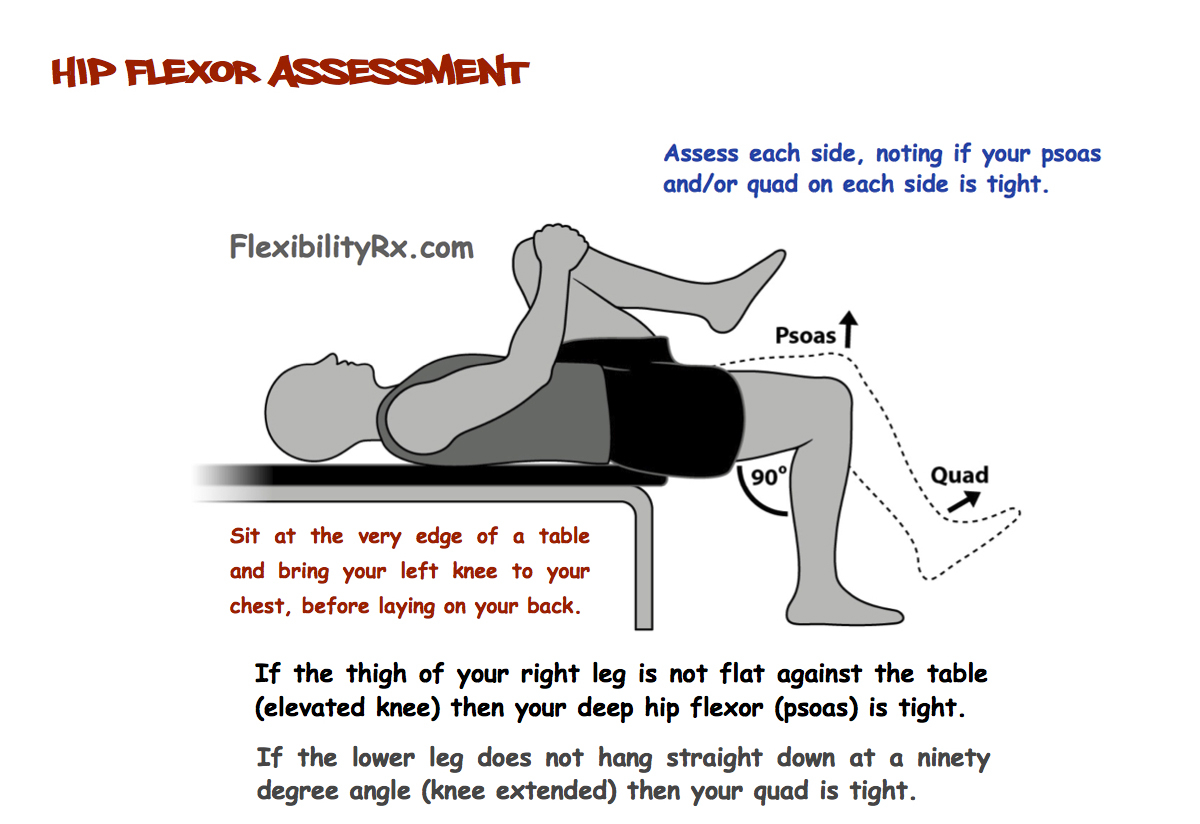
Tight hip flexor muscles, which would limit available hip extension range of motion, are frequently blamed and very well could be the cause. You can test for hip flexor tightness using the Thomas Test and by all means add in some stretches if your thigh is hovering off the table. However, I’m not convinced that the hip needs to extend past neutral–it very much moves backwards/extends from a flexed position but, unless the hip flexors are significantly restricted the requisite mobility in striding is likely less than the athlete’s end range of motion.
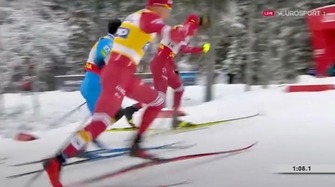
In this screenshot of Bulshunov, known for having a very long (and very powerful) stride, you can see that at the end of his kick phase, his thigh is still slightly in front of his trunk. Either he has very tight hips and can’t extend any further, or striding doesn’t require the hip to go past neutral and into an extended position.
Exercise Remedies
The simple solution is to identify that an athlete is moving too much at the spine and tell them to stop. Maybe even include some video feedback. If they can respond to the cues and correct their form, then job well done. If they can’t make the correction on skis, then we need to take a step back, get in the gym, and work on coordinating isolated hip motion in a less complex setting. It's key to remember that the intent of these exercises is to move the hip independently of the spine. The exercises are listed from easiest to most challenging. They don’t necessarily need to be muscularly fatiguing to be effective; however, if they’re not performed correctly they will be a waste of time (and potentially serve to reinforce a bad habit). A common cue for all of the exercises (and with diagonal stride, for that matter) is keep your rib cage connected to your pelvis. This doesn’t mean flex, crunch, or move your rib cage closer to your pelvis. It does mean, keep the distance between ribs and pelvis the same—if that distance doesn’t change, then the spine is not moving. A couple of sets of 10-15 reps is a good target.
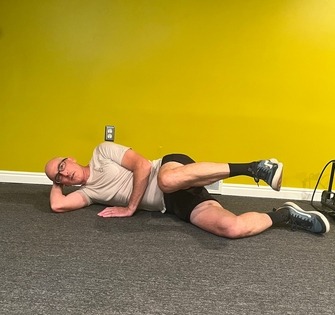
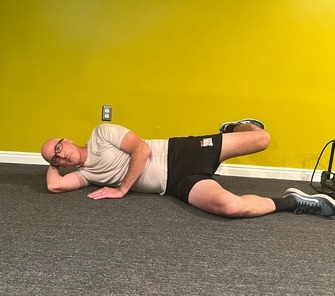
Side Lying Hip Flexion and Extension:
- Lie on your side with both knees bent at 90°
- Lift the top leg so it’s parallel to the floor. Imagine there’s a piece of glass on your leg and we’ve made it into a coffee table. The leg needs to maintain that position–if the knee drops down or goes up as the foot drops, you’ll spill our drinks.
- Now move the top leg forward and backwards making sure the motion is isolated at the hip. You can put a hand on your pelvis to monitor for movement (motion at the pelvis=motion at the spine=no good).
Standing Leg Swing:
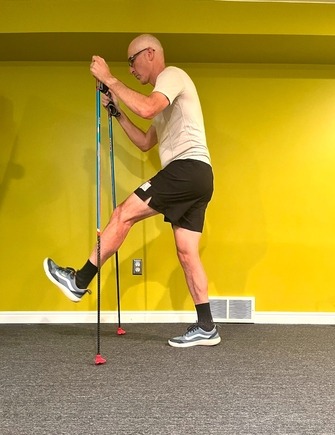
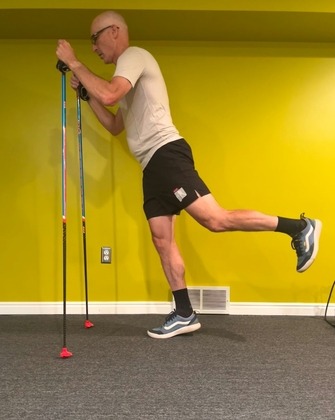
- This is a very common warm-up seen in every start pen from JNQs to the World Cup. And it’s very commonly done incorrectly. What we tend to see is maybe a “more is better” approach where the emphasis is on maximum excursion of the leg vs isolated hip range of motion. Yes, this gets the hips moving, but it also puts a lot of load on the spine and runs counter to this whole concept of isolated hip motion. The more effective method is to perform the leg swing with the same cues as with the previous side lying exercise.
- Use poles or a stationary object for balance support (I’m a huge advocate of balance exercises, and we could make this a balance exercise, but I think it needs to be one or the other and not both).
- Slightly bend the knee of the moving leg so the foot clears the ground.
- Swing the leg front and back, allowing it to move freely at the hip joint while preventing any motion at the spine.
- Less specific to diagonal striding but still a good warm-up is swinging the leg side to side. Same set up and cues, except the leg is going to the side and then across the body. Spine control is about preventing side bending, especially as the leg goes out to the side.
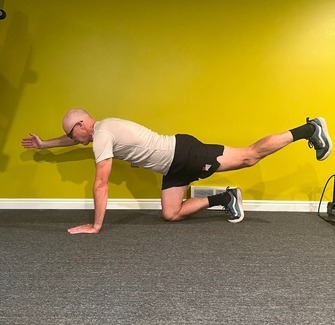
Bird Dog
- From a quadruped position, lift opposite arm and leg
- Alternate sides
- No arching and no rotation
- Progression: bear crawl position (quadruped but with your knees off the ground)
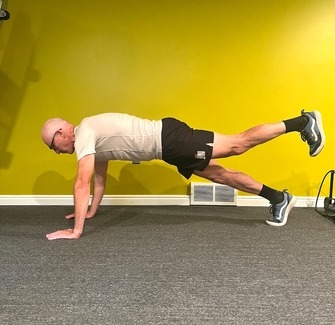
Plank with Hip Extension
- The lower your upper body support, the harder the exercise. Start with hands on a wall and progress to table height then a weight bench then the floor.
- With any of the elevated positions, it’s ok to have a small amount of bend in the knees.
- Alternate Right-Left
- All hip, no spine
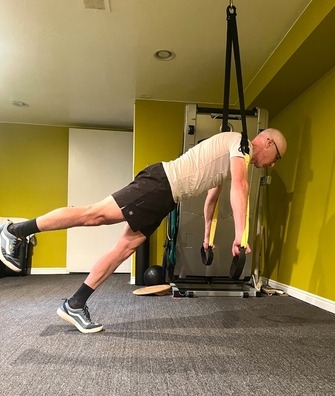
Unstable Plank with Hip Extension
- Same exercise as above but with less external stability
- TRX: full plank holding the handles. The lower the handles, the harder the exercise
- Physioball: plank with forearms on the ball
- BOSU: full plank with flat side up (could be done with forearms on round side up, but this is not especially unstable)
Triple Extension
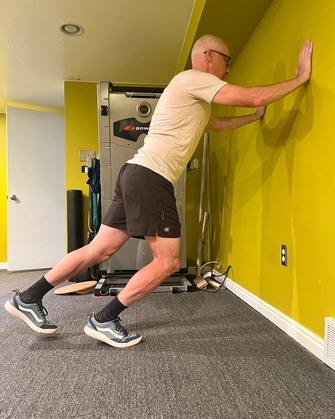
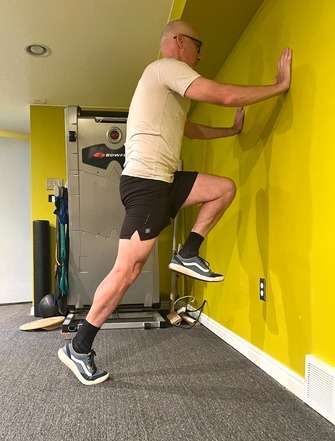
- This is a classic running drill meant to emphasize joint extension through the hip, knee, and ankle. In reality, we don’t actually go to this degree of extension with running, let alone classic skiing. But I wanted to include an exercise that involved hip extension with the foot on the ground like it would be in skiing (all the other exercises involve the leg moving freely in space).
- With both hands on a wall at about shoulder height, stand on one leg about 24” from the wall. Weight is on the forefoot with the heel hovering off the floor.
- Drop into a bit of a squat with the other leg trailing behind.
- Push tall on the stance leg, extending through the hip and knee and lifting the heel high off the floor. The opposite hip, knee, and ankle flex.
- This exercise is often cued to be done with speed–think about snapping from Start to Finish as quickly as possible.
- As is the theme of this article, keep your ribcage connected to your pelvis and move through the legs without moving at the spine.