
Volume Week L1 training
Volume weeks focus on lots of easy distance L1 training. Aerobic cross-country ski training is designed to progress throughout the summer so athletes can build efficiency. While skate skiing or classic skiing completely in L1 might have been challenging for some, a skier's goal should be to build enough specific strength and base efficiency so they can ski with correct technique even in L1 now that weekly training volume is increasing.
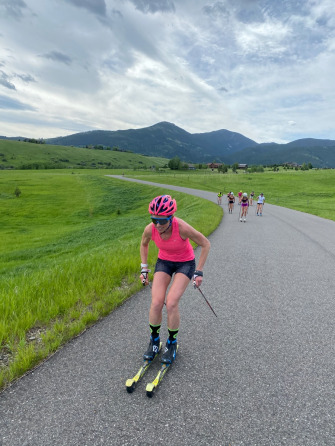 The biggest difference in technique between level one training and level four is power. 90% of ski training is in level one. If you train 600 hours a year that means you will spend 540 hours of training skiing easy. How you ski during those hours will directly translate to how you ski on race day. Your body is much more likely to absorb the technique you use 90% of the time than the technique you use 10% of the time during intervals or speeds. Learning to ski easy with quality movements and good technique will translate to quality technique on race day. When skiing easy I try to keep the initial core crunch and poling impulse the same but remove the power from the follow-through. Andy likes to call this skiing small, or using a more compact version of your typical race technique. Skiing easy doesn’t mean skiing lazy or sloppy. Instead skiing easy should feel eerily similar to skiing fast, just subtract the sweat, suffering and heavy breathing.
Below are some thoughts from Erika Flowers:
As on over-eager young racer, I spent countless hours obsessing over just that: hours. I was the athlete skiing laps around the parking lot at the end of the workout to ensure I stopped at 2:00 and not 1:58. I tracked my heart rate like a hawk to ensure I was always in the right zone and never missed a training session. Although this hyper-attentive approach to training led to moderate success, I made leaps and bounds when I learned to simplify things. During my first few weeks training as a professional skier my coach taught me an important lesson: keep the easy workouts easy and the hard workouts hard.
Most cross-country ski racers have no problem with the going hard bit. Like good endurance athletes, we thrive on the pain, suffering and endorphins gleaned from a tough interval session or hard race effort. The real challenge comes when we are forced to slow down. However skiing fast (and not just hard) requires countless hours of slow, controlled skiing in level one. Quality level one training builds a strong foundation for fast interval sessions and races during the winter. Learning to ski well while skiing easy relies on three things: good technique, complete weight shift, and a stable body position.
Another way to keep speed high while skiing easy is to focus on weight shift. One of my favorite coaches used to say, “Weight shift, weight shift, that’s the key. Weight shift, weight shift, that’s for me.” That mantra should be applied any time you strap on the skinny skis but becomes particularly applicable when skiing easy. Think of weight shift like free energy. It uses little to no power to move from one ski to the other and yet that simple motion can propel you down the track. I like to think about squeezing and activating the glute muscles to help stabilize the knee over the ski each time I switch from one foot to the other. You can even start by just standing on skis and practice shifting from one to the other, balancing for an extra second to make sure you are truly shifting your weight each time.
Finally, maintaining a strong, stable and stacked body position will help translate the energy generated from good technique and a complete weight shift into forward momentum. Think about keeping your hips forward over the skis, staying soft in the ankles and stable throughout the core. The goal is to generate speed with the smallest amount of energy while maintaining race-worthy technique and having plenty of energy and breath to catch up on the latest episode of Big Little Lies. A stable body position helps transfer energy output into speed. Think about trying to javelin a stick versus a big piece of cooked spaghetti. The stick is probably going to travel a lot further because the energy used to throw it all translates into forward motion versus the spaghetti noodle which disperses the energy in a lot of different directions. Basically don’t be a wet noodle.