
Double Poling and v1 - A path to a more powerful v1 for master skiers
By Betsy and Bob Youngman
Introduction
In nordic skiing, one of the most-used freestyle techniques is the V1, and yet V1 technique is a weakness for many skiers and for masters skiers in particular. We’ll get to the reasons for this below, but the importance of a powerful, high turnover V1 cannot be underestimated. Many masters skiers use V1 for substantial portions of races, most (if not all) hills, and for recovery after surges. In fact, some masters skiers use V1 exclusively in racing and training, except for some flats and gradual downhills. However, when observing races and training one will see a high proportion of deficient technique among masters skiers engaging in V1. A skier will be well served to concentrate on developing an efficient and powerful V1, particularly masters skiers where this technique is often utilized.
As one progresses into developing as a competitive cross country skier, there are aspects that continue to stand out as being of primary importance. Those that are well recognized are aerobic capacity (VO2max), skiing efficiency, and full-body strength. What is not well recognized is the overarching importance and impact of a strong, efficient double poling capacity.
The double pole technique cuts across all-important techniques in cross country skiing. Strong, powerful, and efficient double poling technique is critical in classic skiing, V1, and V2. We’ll cover how double poling motions are essential in proper V1 technique here and refer the reader to full coverage over all techniques in an article we published recently that addresses why double poling is the most important competency in competitive cross country skiing.
Note: We use the “on arm” and “off arm” convention for descriptions of V1 technique. Other commonly used terms include “hang pole” and “push pole”, respectively.
Double Pole and V1
If there is one technique that has been muddled by coaches, teachers, and competitors, it is the V1 technique. Our observations have been that coaches and teachers often instruct skiers to bring the secondary or "off arm" across the body and in front of the torso for poling. This position severely limits the ability to develop power from the "off arm" and therefore limits the ability of the skier to take advantage of a strong upper body and core during the V1 motion. As a result skiers are both less efficient and less powerful - a double whammy of deficiency.
Proper V1 technique involves a poling motion that is similar to a classic double pole, where the torso is squared to the direction of travel and the poles are synchronously planted with equal weighting. The same 90-degree arm lock and a very similar follow through (hands going directly back and no further than the hips) are also required. Planting the "off arm" pole at a shallow angle to the deck surface due to bringing the "off arm" across the body, siphons away potential forward motion power by allowing for significant lateral force vectors that develop braking forces which can be significant. These lateral force vectors also move the body sideways and therefore further decrease the efficiency of the ski stroke. Elimination or minimization of these lateral force vectors is important and easily attained by developing and using a more "classic-style" double poling technique accommodated within the V1 stroke. Utilizing this poling motion requires high upper body and core-specific strength that enables support of high force generation from the ”off arm” with a high, shoulder-width, hand position and a more vertical pole plant. Weaker skiers will find doing this difficult and tiring. It’s all too “easy” to bring that “off arm” across the torso and throw it out sideways with a shallow pole plant and, therefore, compromise forward-motion power development. This “error” is seen throughout the spectrum of skiers including World Cup champions as detailed below.
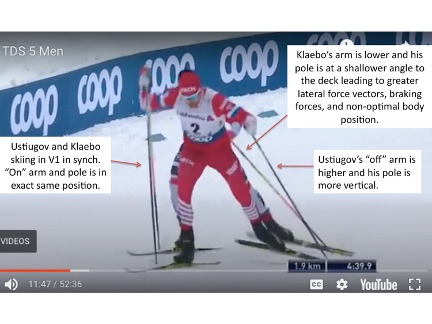
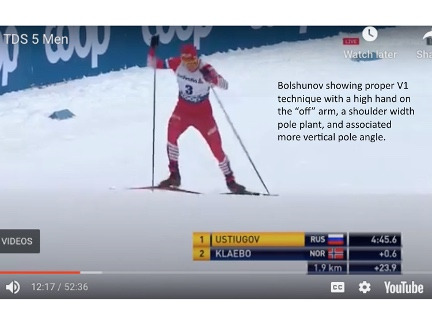
As in all cross country skiing technique, video is the only reliable way to analyze such highly dynamic, multi-limbed motions. In the following video from the 2018/19 Tour de Ski Stage 5 in Oberstdorf starting at about 11:15 Ustiugov and Klaebo climb a hill using V1. Ustiugov has near-perfect technique but Klaebo shows some deficiency. Because they are skiing in-synch (i.e. at the same poling rate and same approximate body position) for substantial periods, the differences are obvious. Note that in Ustiugov the "off arm" never moves inward beyond the shoulder and that the pole plant and actuation is very much like the double pole with a just a minor adjustment due to the body position being shifted off-center and toward the primary or “on arm” and leg. This body position gives a slight angle to the "off arm" pole plant that would otherwise be vertical in a proper double pole, but other than that, the poling motion is a double pole. And that is what it feels like when properly executed- a double pole. In this portion of the video Klaebo shows weakness in his V1 here as one can clearly see that he brings his “off arm” low and further inward than Ustiugov and proceeds to throw his arm out more laterally rather than parallel to the direction of travel. As a result, potential power development is compromised. Just goes to show how anyone can improve! Further on, one can see proper technique in Bolshunov as he comes through just after Ustiugov and Klaebo at about 12:15 where his "off arm" is consistently brought up high, at shoulder-width, and planted nearly vertical and in concert with the "on arm" in a strong and efficient double pole action in V1.
Here are some annotated stills from the video:
Ustiugov and Klaebo skiing in-synch in V1 showing the substantial difference in technique with Ustiugov demonstrating a much more powerful “high hand” position and vertical pole plant. The skiers are in-synch meaning that they are at the same tempo and the same point in the motion but with very different body and pole positions. Note the time stamp and watch the video where the differences will be even more obvious than in this still.
Bolshunov showing near-perfect V1 technique with a “high hand” position on the “off arm” and the associated near-vertical pole plant and squared-up forward facing body position. The”off” arm never comes further inward than shoulder-width and his torso never twists. Again, note the time stamp and watch the video.
Less developed (and muscularly weaker) skiers will bring their "off arm" well across the torso (and often nearly to centerline) in an effort to leverage some power off of a weaker upper body and core strength base that is insufficient to hold and actuate the arm further out where higher power and greater efficiency will be generated. This lateral arm movement also leads to energy-wasting twisting of the torso that adds nothing to forward motion.
For reference, and more typically observed V1 technique, the following video is from the Craftsbury "opener" race in November 2017 that nicely documents many of the improper V1 technique details discussed above. For example, starting at about 0:25 you will see a young skier in V1 going up a hill and bringing his arm low and fully across his torso, substantially compromising power development and efficiency. This is very much what is typically seen in athletes at this level - something that with strength development, neuromuscular drills, and technique tweaks can be transformed into a powerful and efficient V1. There are many other examples in this video showing all of the degrees of deficient V1 right down to the "off" arm essentially being an "accessory" that is not even used for propulsion.
There are a few examples of good technique as well (a couple of the skiers starting at about 1:30 on a steep hill) but still exhibit opportunities for strength and hand position development and therefore a more powerful "off arm" contribution. Clearly, the fastest skiers are those who bring the "off" arm up high and only to the shoulder joint and not further toward centerline. Doing this requires high specific and max strength in the core and upper body.
How to Develop an “Off Arm” High Hand Position in V1
As mentioned above, the ability to maintain a high, shoulder-width, hand position on the “off arm” in V1 is a direct result of high levels of upper body and core-specific strength. Holding significant fractions of body weight in this extended arm position is difficult and requires specific strength from the wrist down through the core and to the foot. In addition, since one’s body weight is slightly shifted off center toward the “on arm”, it is even more difficult to hold the proper position to allow for maximum force generation from the “off” side. Here we review a few strength exercises and ski drills that will help a skier develop a higher “off arm” hand position and the associated strength and neuromuscular adaptations.
Strength Exercises
An efficient and powerful V1 motion is predicated upon an athlete having a fully developed/optimized upper body musculature along with utilization of proper double poling technique. Double poling-specific upper body and core strength training is, as we have noted numerous times in previous articles, key to development of competitive double poling. Deficiencies in upper body and core double poling-specific strength training protocols will lead to lower weight-adjusted power development (ratio of developed power to weight) not only in double poling but in V1 freestyale as discussed above. This reality serves to emphasize the importance of strength training for any competitive athlete, whether they be an elite or a masters competitor.
The prevalence of non-optimized V1 technique (typically due to a “low” hand position on the “off arm”) among masters skiers is likely due to strength deficiencies. We have addressed strength training for maters athletes in a prior article but provide here a few suggested max strength and general strength exercises that will help develop the specific-strength needed for proper V1.
Since in V1 we are attempting to develop an ability to reach relatively high with the hand on the “off arm”, exercises that replicate this motion will map well onto improved V1. Exercises that emphasize this include weighted pull-ups, garhammers, L-sit pull-ups, and “double pole” squats. In each of these exercises the hand starts high and requires support of substantial fractions of body weight through a poling-like motion. The garhammers, L-sit pull-ups, and “double pole” squats also involve dynamic movement of the core in a way not dissimilar to what one will do in the V1 poling motion. Integrating these exercises into your strength program will enable proper V1 technique (including a high hand position on the “off arm”) and substantial associated increases in power development.
Ski Drills
In addition to specific strength development, neuromuscular adaptations that “wire” poling motions are very important. The purpose here is to engage with drills that will help make a “high” hand position on the “off arm” automatic with little to no active thought. As we have discussed previously in an article on herringbone, the process of making a motion “automatic” is called myelination and can only be achieved with repeated drills, preferably on skis or roller skis.
We find two ski drills to be quite functional for helping a skier achieve a “high” “off arm” hand position in V1:
“Fives”: Find a flat-to-gentle upslope trail or road section and repetitively do a sequence of five V1 left side, five double pole strokes, and five V1 right side. This can be done continuously for 5-10 minutes or for up to 30 minutes in appropriate terrain (flat-ish loops work best). The drill reinforces the “double pole”-nature of V1 poling by reminding the skier on every other stroke what a true double pole feels like and then immediately going into a V1 stroke and trying to maintain the same high, shoulder-width, hand position utilized in the double pole. This drill will naturally develop one’s sense of what a high V1 “off arm” hand position should feel like and allow for individuals to identify cues for ensuring that the “off arm” hand stays consistently high. Another output of this drill helps skiers develop both a left and right side V1. Many skiers tend to favor one side over the other. This is not desirable as in certain terrain conditions, like a transversely sloped trail, the “on arm” should be on the down slope side. If a skier only has, say, a right V1 and the down slope is to the left, a V1 with the right “on arm” will be compromised because the skier will be reaching higher up the slope, making poling on that side more difficult.
“Single Pole V1”: Again, find a flat-to-gentle upslope trail or road section and repetitively do a few V1 (right or left) strokes followed by a few V1 strokes with just the “on arm” pole, then a few strokes with just the “off arm” pole, and then back to a full “double pole” V1. 5-10 minutes of duration will supply a significant neuromuscular stimulus. This drill is designed to demonstrate how important the “off arm” poling is to a powerful V1. Many skiers perceive that most, if not all, poling power is coming from the “on arm” poling. Running through this drill will quickly demonstrate how much poling power one can get from the “off arm”, particularly with a “high”, shoulder-width, hand position. The same applies to leg push-off in V1as is nicely addressed by NTS here.
Turnover is also very important in V1, particularly on steep hills. We will address this aspect in another article but a strong and high “off arm” hand position is the first and most critical part of perfecting your V1. Increased competence in that ability will be a direct result of specific strength training and some simple on-ski drills.
Summary
We have reviewed the importance of a well-developed double poling capacity in V1. Given the preponderance of the use of V1 by many masters skiers, it is important that masters skiers focus on developing their double poling capacity. We have outlined some specific-strength and ski drills that can be used to address an individual skier’s weaknesses.
More generally, the double poling motion and associated muscle groups, particularly the upper body and core musculature, play a central role in virtually all important cross country skiing techniques, both classic and freestyle. Given the broad applicability of a well-developed double poling capacity, it is important for competitive cross country skiers to place significant emphasis on those aspects of training that will most substantially improve one's double pole capacity. These training aspects include significant, challenging, upper body and core strength protocols in combination with double pole technique refinements. Such training aspects are of heightened importance for the masters skier, where continuing (age-related) challenges with muscle loss necessitate a year-round intensive and integrated strength program to ensure that strength levels do not decline. Mapping a strong double pole capacity onto V1 will enable a skier to consistently maintain a high, shoulder-width, “off arm” hand position and a more “double pole”-like poling motion, thereby deriving significantly increased power and pace in V1.