
Fuel to Perform, Fuel to Stay Healthy - Part 1
Fuel to Perform, Fuel to Stay Healthy: Translating Sports Nutrition Science into Practice for Cross-Country Skiers
By Marietta Sengeis, Nicky Keay & Isabella Grabner-Wollek
The physiological demands of cross-country skiing are characterized by a combination of prolonged aerobic exercise and repeated high-intensity efforts. Energy expenditure is exceptionally high, with metabolic demands varying according to terrain (uphill, downhill & varying snow and environmental conditions), race format, and skiing technique (skating & classical). Successful performance depends not only on superior aerobic fitness but also on the capacity to repeatedly produce high-intensity efforts while maintaining technical efficiency under fatigue. Athletes participating in numerous endurance sports, including winter sports such as cross-country skiing and biathlon, may be at risk of low energy availability (LEA) (Gawelczyk , et al., 2025) . Therefore, sufficient carbohydrate availability is regarded as a key factor for sustaining performance and optimizing recovery in elite cross-country skiers (Ørtenblad, et al., 2026) .
From Theory to Practice:
The Athlete's Plate®, introduced by Nanna Meyer (Colorado Springs, USA), has been established as a practical visual tool for communicating appropriate macronutrient distribution in relation to training demands. Relevant publications by Meyer and colleagues provide the scientific basis for this concept (Reguant-Closa A, et al., 2019) . Later studies evaluated its environmental sustainability (Reguant-Closa, et al., 2020) and ultimately led to the development and validation of the Vegan/Vegetarian Athlete's Plate®, thereby extending the original framework to support athletes adhering to plant-based dietary patterns (see Figure 1) while maintaining sport nutrition recommendations (Lynch, et al., 2026) .
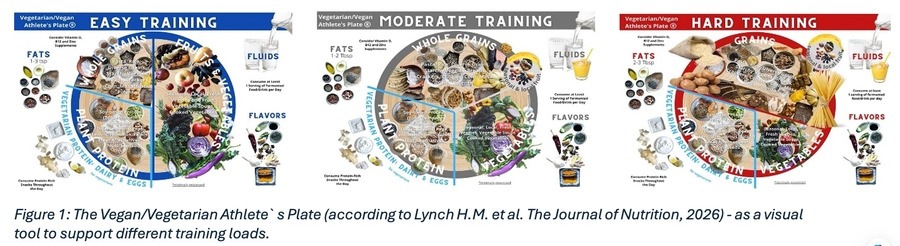
A persistent challenge in sports nutrition is translating evidence-based recommendations into practical dietary behaviours. The Athlete's Plate addresses this gap by providing a simple, visually intuitive framework that helps athletes understand and implement appropriate food group proportions according to their training load. While this approach facilitates nutrition education and meal planning, it does not evaluate actual dietary intake. Therefore, documenting food intake using a structured dietary record (over three days) is recommended to assess whether individual energy and nutrient requirements are being met. Subsequent analysis and interpretation by a qualified sports dietitian or nutrition professional can help identify nutritional inadequacies, provide individualized feedback, and support the optimization of dietary practices.
Beyond dietary assessment, the integration of body composition measurements into individualized (face-to-face) nutrition consultations is a valuable tool in sports nutrition practice. When performed using accurate, valid, reliable, and standardized methods (Müller, et al., 2016; Störchle, et al., 2017) , body composition assessment provides useful information (Sengeis, et al., 2021) for monitoring training adaptations and guiding individualized nutrition strategies in weight sensitive sports. However, only valid, and reliable assessment methods should be used. If accurate measurements cannot be ensured, it is preferable not to perform the assessment, as inaccurate data may confuse rather than support the athlete.
Equally important is the way nutrition information is communicated. Although food is often associated with culture, enjoyment, and social interaction, within elite sport it also represents a fundamental component of recovery, adaptation, and long-term performance. Consequently, nutrition counselling should foster a positive and supportive relationship with food rather than focusing solely on performance outcomes or body composition. Establishing trust, improving nutrition literacy, and empowering athletes to make informed dietary decisions are therefore central objectives of effective nutrition support. Visual education tools, such as the Athlete's Plate, have proven useful in translating scientific recommendations into practical and understandable guidance.
In addition to explaining what athletes should eat, practitioners should also emphasize why adequate nutrition is essential. Understanding the physiological consequences of insufficient energy or nutrient intake—including impaired recovery, altered endocrine function, compromised bone health, and reduced training adaptations—can improve athletes' appreciation of the role of nutrition in supporting health and performance. This physiological perspective provides the foundation for discussing the broader concept of energy availability and its endocrine and metabolic consequences.
Understanding the physiological consequences of LEA can improve athletes' appreciation of the importance of adequate nutrition. The conceptual framework developed by Nicky Keay (see Figure 2) illustrates how endocrine dysregulation resulting from LEA affects multiple physiological systems, ultimately compromising health, recovery, and performance. Such visual representations are valuable educational tools that help translate complex physiological concepts into practical understanding for athletes (Keay, 2022) .
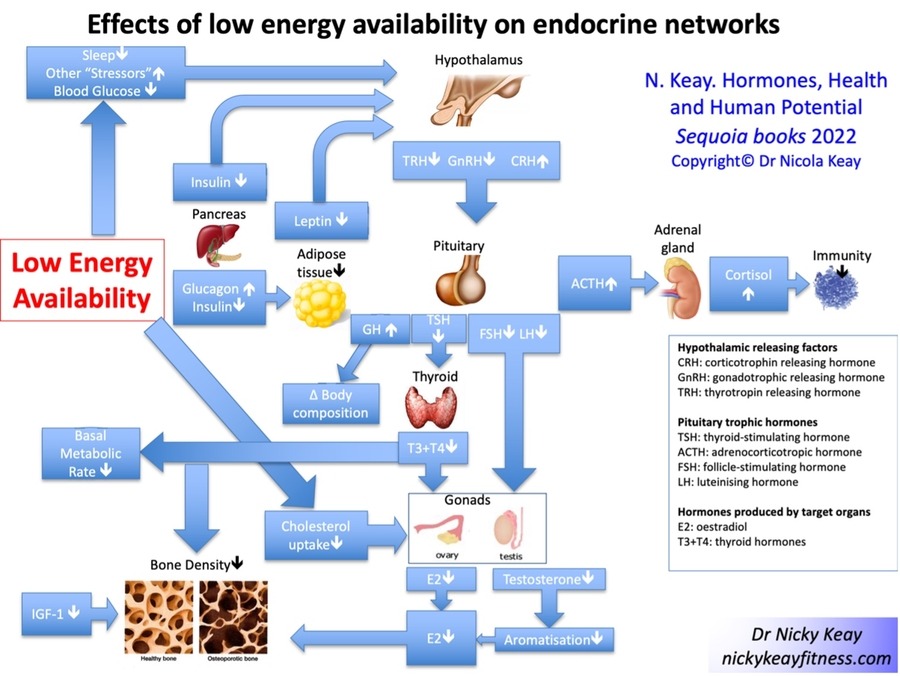
Figure 2: Effects of low energy availability on endocrine networks - by Nicky Keay.
Low Energy Availability and the Body’s Response
When energy intake is too low (either intentionally through reduced food intake or unintentionally due to increased training demands, such as during training camps without adequate nutritional adjustments) to meet the demands of training and daily life, the body adapts by activating energy-saving mechanisms. Available energy is prioritized for essential functions, while processes that require more energy—such as growth, recovery, and reproduction—may be reduced.
LEA influences several hormones involved in metabolism and energy regulation. At the same time, physical stress from insufficient fuel and external stressors like poor sleep can affect the brain’s hormone control system. The hypothalamus combines these signals and adjusts hormone activity accordingly.
As a result, prolonged LEA can reduce the function of important systems, including thyroid and reproductive hormones, which may negatively affect health, recovery, and athletic performance (Keay, 2022) .
“All aspects of health: menstrual function in women, testosterone levels in men, bone health, metabolic rate, growth and development, psychological, cardiovascular, gastrointestinal and immunological and haematological systems are adversely affected by the underlying endocrine disruption of RED-S. These occur over different time scales” (Keay, 2022) ; see Figure 3.
As highlighted by (Emily Todd , et al., 2022) , menstrual dysfunction (primary and secondary amenorrhoea) and impaired reproductive function should not be normalised within sport culture.
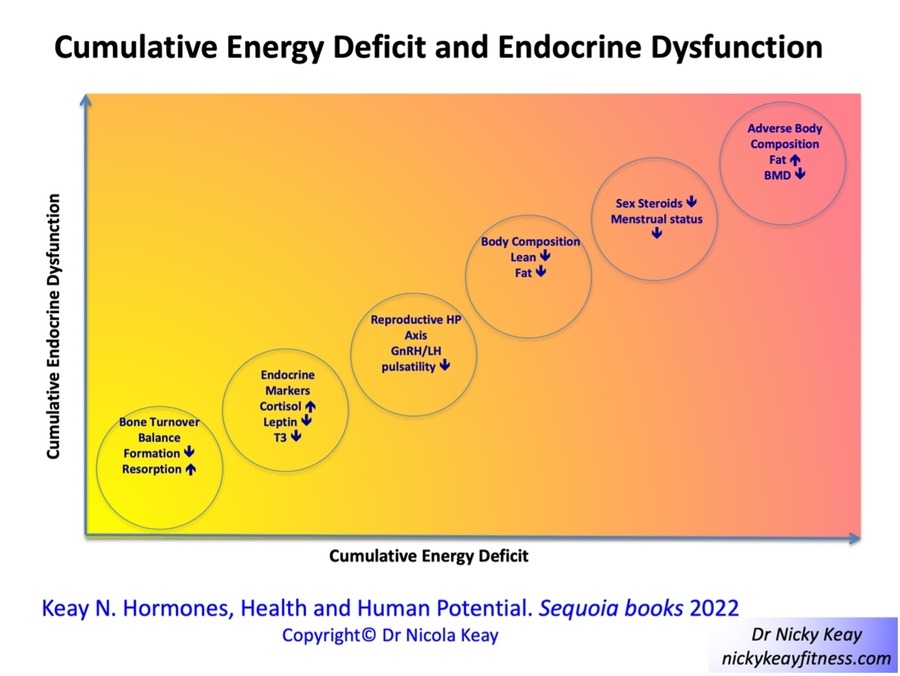
Figure 3: Cumulative energy deficit and endocrine dysfunction.