
Fuel to Perform, Fuel to Stay Healthy - Part 2
By Marietta Sengeis, Nicky Keay & Isabella Grabner-Wollek

References
Low Energy Availability and Bone Health
Bone is a living tissue that is constantly being rebuilt and repaired. While weight-bearing exercise normally strengthens bones, this process requires enough energy and nutrients to support healthy hormone function.
When the body does not receive enough energy—especially carbohydrates and protein around training—bone formation decreases, and bone breakdown increases. Over time, repeated underfueling can disrupt hormone balance and negatively affect bone health.
In short: Training provides the stimulus for strong bones, but sufficient fueling provides the foundation for adaptation and recovery.
Fueling Strategy in Focus: Meeting the Body’s Energy Demands for Training, Recovery, and Health
Free online tools can provide an initial insight into lifestyle behaviours, training habits, and potential areas for improvement. Use them as an opportunity to better understand your body and recognise possible warning signs. However, self-assessment is only the first step—when concerns arise, seek guidance from qualified experts who can provide individual support.
The Personal Energy Availability Questionnaire (PEAQ) https://mypeaq.streamlit.app/ questionnaire, developed by Dr. Nicky Keay, consists of 26 questions that provide insight into your fueling habits, training load, recovery, and potential signs of LEA. The PEAQ is supported by scientific research and can help screen for potential issues related to energy availability. It is not intended to replace professional medical assessment or individualized healthcare advice. Further, the “Within-Day Energy Balance Calculation App” developed by Jeffrey Rothschild may be also a usable tool that helps illustrate the relationship between energy intake and training demands throughout the day.
Torstveit MK and colleagues (Torstveit, et al., 2023) highlighted that preventing REDs requires a multidisciplinary team approach. Healthcare professionals (e.g., physicians, physiotherapists, dietitians, psychologists, and physiologists), together with coaches, parents, managers, and sport organisations, play an essential role in supporting athlete health and reducing the risk of REDs. While primary prevention aims to reduce the risk of developing REDs, it is equally important to recognise early warning signs and prevent progression. Athletes should have access to appropriate support within their sporting environment, including qualified coaches and healthcare professionals, when concerns arise. Important signs to monitor include menstrual disturbances, reduced libido, persistent fatigue, recurrent illness, injuries, psychological changes, and problematic eating behaviours (Torstveit, et al., 2023) .
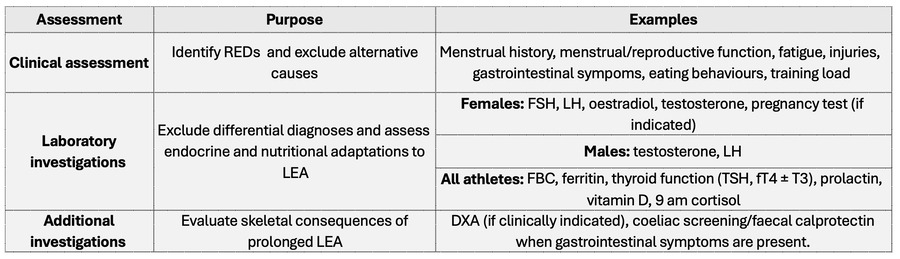
According to Torstveit and colleagues (Torstveit, et al., 2023) , several screening tools are available to help identify early signs and symptoms of REDs, including questionnaires such as the LEAF-Q, LEAM-Q, and other REDs screening tools. These instruments support early identification but should be combined with professional assessment when concerns are present. According to (Emily Todd , et al., 2022) purpose of laboratory investigations is to exclude alternative diagnoses and identify endocrine adaptations associated with LEA. However, laboratory findings should always be interpreted alongside the athlete’s clinical history, symptoms, and training load, as normal blood results do not exclude REDs.
Table 1: REDs: Overview of assessment options for REDs based on current literature: (Emily Todd , et al., 2022) & (Mountjoy, et al., 2024) .
Abbreviations: BMD = bone mineral density; DXA = dual-energy X-ray absorptiometry; FBC = full blood count; FSH = follicle-stimulating hormone; fT4 = free thyroxine; LEA = low energy availability; LH = luteinising hormone; REDs = Relative Energy Deficiency in Sport; T3 = triiodothyronine; TSH = thyroid-stimulating hormone.
However, screening alone is not enough—knowledge and awareness are essential to recognise warning signs and seek appropriate support. Therefore, experts have developed educational platforms such as www.red-s.com to provide reliable, evidence-based information on REDs and athlete health – “By athletes. For athletes”.
As mentioned above, REDs screening requires a multidimensional approach (Mountjoy, et al., 2024) . Questionnaires and clinical interviews help identify risk factors and symptoms, while blood biomarkers and DXA can provide objective information about physiological consequences, particularly hormonal disruption, and impaired bone health. No single marker can diagnose REDs independently.
“The expected timeline for recovery from REDs is variable and depends on multiple factors, such as the specific REDs condition, the severity, the presence of other medical issues and the underlying cause of LEA” (Torstveit, et al., 2023) .
Practical perspective
Preventing REDs requires more than recognising symptoms—it requires creating an environment where athletes have the knowledge, resources, and support needed to meet their physiological demands. Education should therefore be considered a cornerstone of prevention, with a focus on understanding energy availability, adapting nutrition strategies to changing training loads, and recognising periods of increased risk.
Providing accessible and appropriate nutrition, including practical options such as meals and snacks during training, competitions, and camps, is particularly important for adolescent and elite athletes, whose energy requirements can fluctuate significantly throughout their sporting development.
Throughout an athletic career, periods of nutritional challenge, increased training demands, injury, or life stress may occur. Experiencing difficulties with maintaining energy balance does not represent failure; rather, it highlights the importance of having a supportive and knowledgeable team around the athlete. Coaches, healthcare professionals, nutrition experts, and the wider support network play a key role in identifying challenges early, providing guidance, and supporting sustainable performance alongside long-term health.
Emily Todd , E., Elliott, N. & Keay, N., 2022. Relative energy deficiency in sport (RED-S). British Journal ofGeneralPractice, Volume 72, p. 295–297.
Gawelczyk , M., Kaszuba, M. & Petr, M., 2025. Nutritional Strategies for Olympic Biathletes: A Practical Review. Nutrients, Volume 17(21), p. 3385.
Keay, N., 2022. Scene 10: In the Red. In: Hormones, Health and Human Potential. 1 ed. s.l.:Sequoia Books, pp. 161-185.
Lynch, H. M., Reguant Closa, A. & Meyer, N., 2026. The Development and Validation of the Vegan/Vegetarian Athlete`s Plate®. The Journal of Nutrition, Issue 101720.
Mountjoy, M. et al., 2024. 2023 International Olympic Committee’s (IOC). Br J Sports Med, Volume 57, p. 1073–1098.
Müller, W. et al., 2016. Subcutaneous fat patterning in athletes: selection of appropriate sites and standardisation of a novel ultrasound measurement technique: ad hoc working group on body compsition, health and performance, under the auspices of the Medical Commission. Br J Sports Med, Issue 50, pp. 45-54.
Ørtenblad, N., Holmberg, H., Nybo, L. & Gejl, K. D., 2026. Carbohydrate Storage and Supplementation Strategies for Peak Performance in Cross-Country. Scandinavian Journal of Medicine & Science in Sports.
Reguant-Closa A, A., Harris , M., Lohman , T. & Meyer , N., 2019. Validation of the Athlete's Plate Nutrition Educational Tool: Phase I. nt J Sport Nutr Exerc Metab. , Issue 29(6), pp. 628-635.
Reguant-Closa, A. et al., 2020. The Environmental Impact of the Athlete`s Plate Nutrition Education Tool.. Nutrients, Issue 12.
Sengeis, M., Müller, W., Störchle, P. & Fürhapter-Rieger, A., 2021. Competitive Performance of Kenyan Runners Compared to their Relative Body Weight and Fat. Int J Sports Med, Volume 42(04), pp. 323-335.
Störchle, P. et al., 2017. STANDARDIZED ULTRASOUND MEASUREMENT OF SUBCUTANEOUS FAT PATTERNING: HIGH RELIABILITY AND ACCURACY IN GROUPS RANGING FROM LEAN TO OBESE. Ultrasound in Med. & Biol, 43(2), p. 427–438.
Torstveit, M. H. et al., 2023. Primary, secondary and tertiary prevention of Relative Energy Deficiency in Sport (REDs): a narrative review by a subgroup of the IOC consensus on REDs. Br J Sports Med, Volume 57, pp. 1119-1126.
Contacts:
Mag. Dr. scient. med. Marietta Sengeis – info@m-sc.at, Dr. Nicky Keay - nicky@nickykeayfitness.com & Mag. Isabella Grabner-Wollek – i.grabner@icloud.com