
The PoweR of Uphill Training
By Sarah Willis, PhD
(Sarah is a doctoral student/teacher assistant at the university of Lausanne and previously worked at the Swedish Winter Sports Research Centre.)

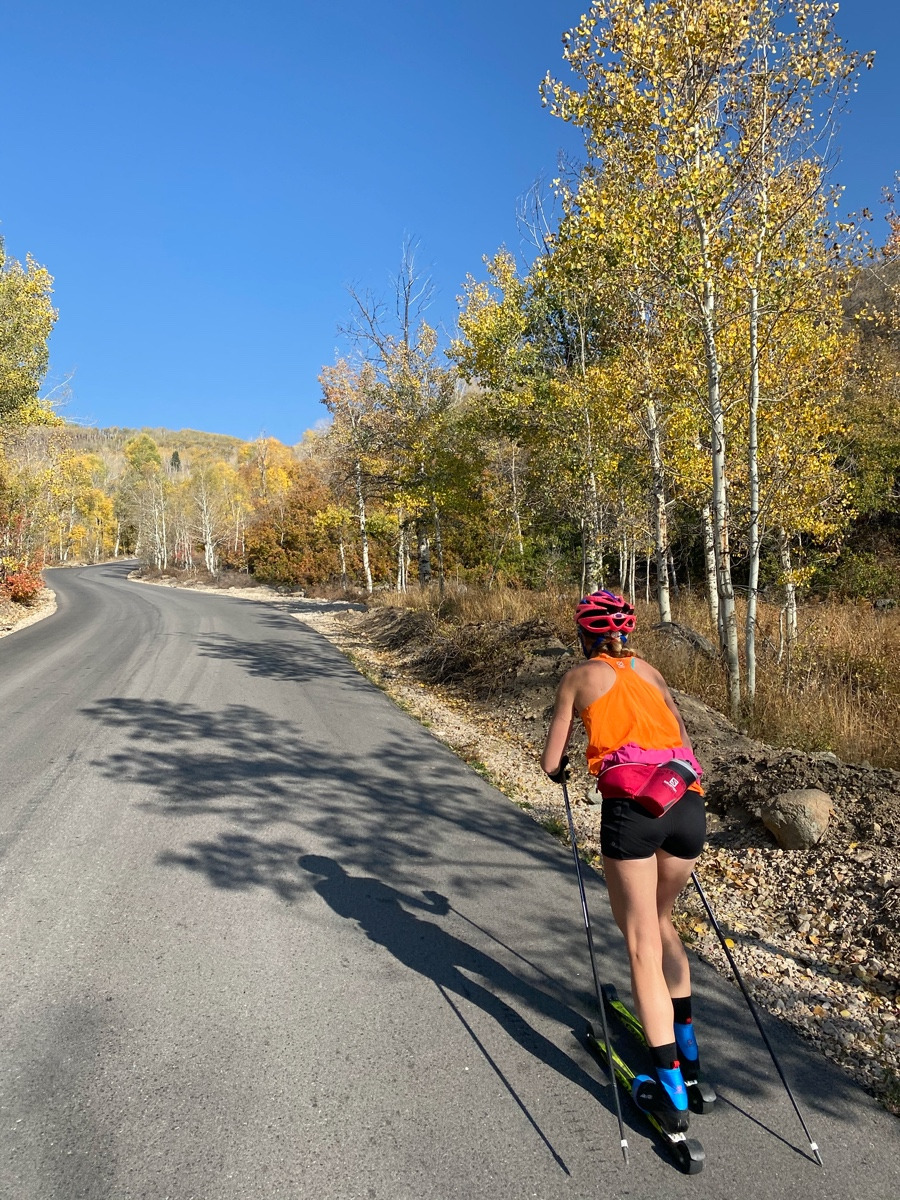
There is great fitness to gain in a short time frame when incorporating more uphill work into
our training sessions. When we move our bodies uphill, the intensity is naturally higher as our heart, lungs, and muscles need to work harder in order to deliver oxygen to our muscles for moving our body both forward and up simultaneously. The adaptations of uphill training improve our overall physiology and performance primarily through the systems of: pulmonary (lungs and oxygen inspiration from the air), cardiovascular (heart and movement of oxygenated blood to our muscles), muscular (muscles to gain endurance strength and efficiently perform work), and neuromuscular (motor skills and proper execution of body movements). With uphill training, though we work harder, we gain strength in our movements and at the same time develop our cardiovascular system to become fitter and faster.
Though XC ski competition terrain varies, regulated races are obligated to include about a third of the race in uphill terrain, a third in flat, and a third in downhill. This means that the majority of time (more than 50% of race time) we spend during a race is in uphill terrain (Sandbakk et al., 2011). Furthermore, XC skiers are known to have a pacing strategy using higher intensity in uphill sections (supramaximal paces higher than that to attain maximal oxygen consumption during a VO2max test) while utilizing the downhill sections to recover (Sandbakk et al., 2011; Norman and Komi, 1987). It has been proposed by early researchers that elite skiers have mechanical power output in uphill terrain of 100-120% of estimated VO2peak (Norman and Komi, 1987). In recent studies of simulated roller skiing race effort on a laboratory treadmill demonstrated work rates of 100-160% of VO2peak during a 15km time-trial (Karlsson et al., 2018) and 120-130% of VO2peak during uphill sections of a simulated roller skiing sprint time trials (Andersson et al., 2017), while an outdoor roller skiing time-trial was replicated indoors indicating that high aerobic work rates were certain (90-95% of VO2peak) (Gløersen et al., 2019). Whether or not the skier reaches maximal oxygen consumption aside, the main finding is that XC skiers have near maximal or supramaximal work rates during uphill sections of races. Therefore, it is important to spend a large portion of our training in uphill terrain to become more economical (using less energy for movements) at moving the limbs to carry the body forward but also uphill as fast as possible.
XC skiing is quite a unique sport, physiologically, as skiers combine movements of both the upper and lower body (overall a greater amount of muscle mass) which require a high cardiovascular demand. When we are exercising in uphill terrain using the upper and lower limbs (skate or classic skiing, bounding, running…) we can effectively “push” all our capacities including the arms, legs, and lungs. This is exaggerated when in uphill terrain versus flat, where, for example we may not be able to challenge the muscle strength of our legs and our lung capacity since we lack the speed and leg turnover in flat terrain; or during cycling, where there is a great ability to exhaust the legs but not our lung capacity. With uphill training, we recruit more muscle motor units to lift our body up the hill/mountain and greater muscle activation which leads to greater strength over time. In addition to the strength adaptations, the cardiovascular stress of uphill efforts increases allowing improved capacity to first get enough oxygen into your lungs and then pump the blood to the muscles. The more muscles that are working (upper and lower body), the more challenge is placed on the cardiac output, which is the ability to provide all working muscles enough blood flow to function and move your body uphill.
Uphill exercise is an incredible training tool to gain fitness, it is efficient in principle, allows combined benefits of strength and endurance, and is generally low-impact. A variety of uphill training can be beneficial for certain injury rehabilitation strategies as there is lower impact and less biomechanical stress on the joints and tendons, as well as use of slower speeds to ease back to training after injury by hiking, running, skiing uphill.
In some ways, as much uphill training as possible is a good thing since we can gain fitness in a short time frame while also building strength. That being said, it is important to also concentrate sessions on maintaining and developing technique and speed in the more flat terrain to be comfortable in all kinds of terrain and continue optimizing the specific skill sets of our many skiing techniques.
Great training sessions for uphill training include:
- Intervals (VO2max, short, specific strength, sprint)
- Sustained threshold efforts (larger blocks of time spent near the anaerobic threshold)
- Long slow distance, low-intensity (mountain adventures, sustained climbing, multiple repetitions on short hill)
Creative training ideas:
- If your hill is not big enough and/or long enough, consider wearing a waist belt and dragging something behind you to increase the resistance (rubber car tire, sled with weight – also in the snow, etc.)
- Consider combining threshold or long slow distance uphill training work with strength exercises directly afterwards to continue to challenge the muscle and simulate uphill to downhill transitions (whether this is on the treadmill followed by gym or on the mountain followed by some exercises in a park or parking lot). Take some dry clothes and a recovery snack between workouts and push on for a big adventurous effort (for the body and mind).
References
Sandbakk, O., Ettema, G., Leirdal, S., Jakobsen, V., and Holmberg, HC. (2011). Analysis of a sprint ski race and associated laboratory determinants of world-class performance. Eur J Appl Physiol 111(6):947-57.
Norman, R.W. and Komi, P.V. (1987). Mechanical energetics of world-class cross-country skiing. Int J Sport Biomech 3:353-69.
Karlsson, O., Gilgien, M., Gloersen, O.N., Rud, B., and Losnegard, T. (2018). Exercise intensity during cross-country skiing described by oxygen demands in flat and uphill terrain. Front Physiol 9:846.
Andersson, E., Bjorklund, G., Holmberg, H.C., and Ortenblad, N. (2017). Energy system contributions and determinants of performance in sprint cross-country skiing. Scand J Med Sci Sports 27(4):385-398.
Gløersen, Ø., Gilgien, M., Dysthe, D.K., Malthe-Sørenssen, A., and Losnegard, T. (2019). Oxygen uptake, demand and deficits in elite cross-country skiers during a 15 km race. In: Gløersen (ed) On the bioenergetics of cross-country skiing, PhD thesis, University of Oslo.