
Importance of training at both low and high intensities (focus on L3 and L4)
By Sarah Willis, PhD
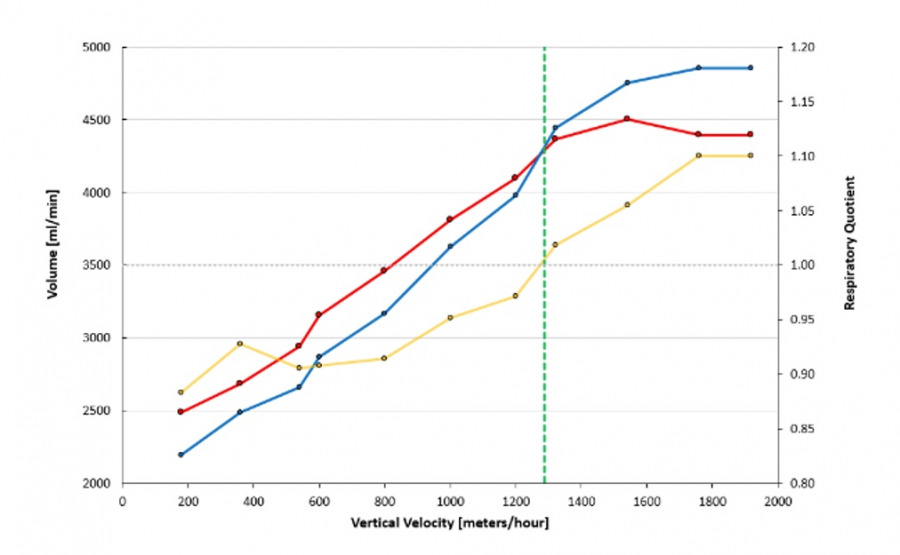
Level 3 is commonly known as “threshold” where the purpose is to increase efficiency of movement while building endurance and sport specific strength. The time training in L3 also works to improve technique and ultimately strives to perform less work to go the same pace. This would transfer to oxygen uptake (VO2) test results demonstrating a ‘right shift’ in the graph of the point at which the body begins to expire more CO2 than what it can process (becoming more anaerobic and producing more blood lactate, the byproduct of glycolysis), as seen below with the dotted vertical green line (where the respiratory quotient surpasses 1.0, the ratio of the volume of CO2 expired / the volume of O2 inspired). This improvement demonstrates better fat oxidation for energy metabolism, the use of fat as fuel. Altogether demonstrating that training in L3 improves the energy cost and therefore performance.

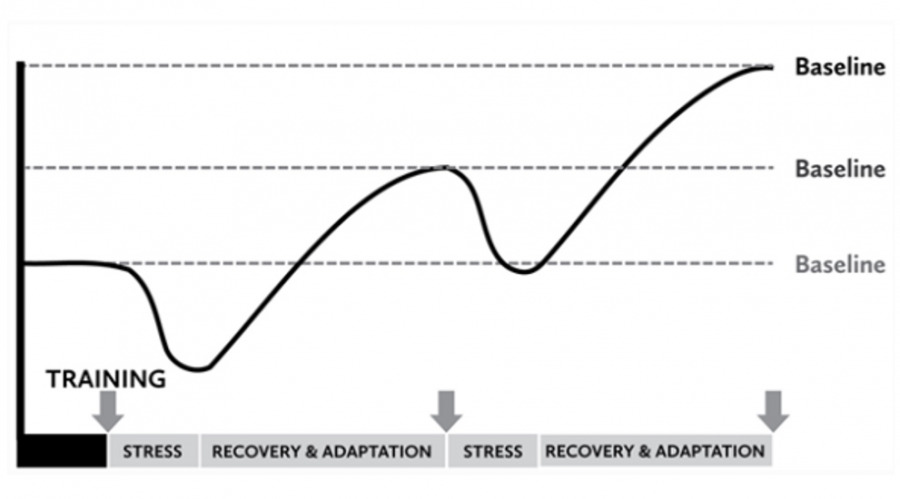
Training is a process that happens over time with several years of dedicated time and effort to achieve your goals. There are different cycles to break this process down: macrocycle, each season as a whole (10-12 months); mesocycle, a particular training phase (ranging between 2-6 weeks); microcycle, one week of training; and individual sessions. There are certain goals for each cycle depending on the main goal, time frame for achievement, and what improvements need to be accomplished along the way. For example, the mesocycle might include phases of preparation both general and specific, competition including pre-competition and tapering, peaking for performance, and transition. Within each phase of the mesocycle, training programs generally include some kind of ‘wave pattern’ in training which alternates (several combinations) between intensity and volume for recovery/regeneration. It is important to fluctuate between inducing a training stress or stimulus (i.e., intervals, increased effort/strength, specific strength/skills, etc.) and recovery to allow for adaptation to take place. Following recovery, there is a supercompensation where the performance rises above that of baseline and forms a ‘new baseline’ to begin the next wave of training. Over time this basis of performance continues to improve, but only when there is proper recovery and adjustment based on the body’s response to the various training stress. Therefore, emphasizing the importance of a wave pattern in periodized training is key to success.
In general, the same kind of training is known to produce adaptations for somewhere between 5-6 weeks. Fast adaptations might be made within 2 weeks, but stabilization of the focused goals during that training phase need between 3-6 weeks. This is demonstrated with the large-scale periodization models used throughout the year in the mesocycle, which focus on different training stimuli to best prepare for competition and peak performances.
This wave pattern is especially important within the microcycle (each week of training), as the body faces different forms of ‘stressful’ training sessions (such as interval days). It is important to allow recovery and time for adaptation after inducing a stressful training load which will maximize the benefits. The body needs to go easy in order to recover and reap the benefits from the hard sessions. Training with high intensity all the time is not effective, as this leads to overtraining and exhaustion which inhibits the response to the stimulus. At the same time, if we go easy all the time, we will not be able to perform at high speeds and therefore loose those abilities. There is a fine balance for coaches and athletes in order to keep the challenge alive in training to stimulate the body in different ways, and to be able to absorb the adaptation and thus improvement in performance.
Regarding the individual sessions…though the athlete may aim to be the best sprint skier in the world, it is not possible to spend large amounts of time training at high intensity since it is too fast/hard of an effort which requires greater muscle power and the ability of muscles to function from chemical energy stores (without immediate use of oxygen for metabolism). Therefore, high intensity training sessions including stimulating efforts need to be interspersed with recovery periods.
A general aim for improving fitness is to spend time training in each of the training zones (based on heart rate, pace, etc.) and become more efficient. Training zones should be adjusted and planned within the mesocycles of the season and focused on the performance goals. In the beginning of the season or early in each mesocycle, an introduction to each type of intensity/training method should be made to be able to naturally progress and build throughout the season or training phase. As an example, level 3 (L3) sessions (an effort which can be maintained for about 1 hour) could start with 3 x 8 minute sessions in the beginning of the season and progress throughout different mesocycles to 3 x 25 minute sessions near to the competition phase. In any situation (level 3 longer intervals, level 4 intervals, short sprints, spenst/plyometric, specific strength, etc.), the aim is to fine tune the efforts and mimic race-like situations as the competition period approaches.
Level 3 is commonly known as “threshold” where the purpose is to increase efficiency of movement while building endurance and sport specific strength. The time training in L3 also works to improve technique and ultimately strives to perform less work to go the same pace. This would transfer to oxygen uptake (VO2) test results demonstrating a ‘right shift’ in the graph of the point at which the body begins to expire more CO2 than what it can process (becoming more anaerobic and producing more blood lactate, the byproduct of glycolysis), as seen below with the dotted vertical green line (where the respiratory quotient surpasses 1.0, the ratio of the volume of CO2 expired / the volume of O2 inspired). This improvement demonstrates better fat oxidation for energy metabolism, the use of fat as fuel. Altogether demonstrating that training in L3 improves the energy cost and therefore performance.
The remainder of this article will focus on the difference and importance of training at both level 3 and level 4 intensity.
L3 is a common training session performed throughout the majority of the year, but there are certain phases in which more L3 can be included. For example, during the pre-competition or throughout the competition phase, it can be beneficial to perform more L3 training (even for ‘fast adaptation’ around 2 weeks) to hold onto this base and extend the foundation of this intensity to be able to better perform for the length of the season. A strong base of L3, efficiency work is important for building sport specific endurance strength. Being able to perform in L3 no matter the snow conditions/physical feelings/situations/etc. also gives confidence for fast but relaxed performance. Together, L3 training is clearly beneficial in the longer races of the season, but also translates to skiing with greater efficiency and strength no matter the distance in order to: use less energy to ski the same pace (be more relaxed), facilitate reaching into the L4+ gears during races, and also to recover better from the L4 to L5 efforts while chasing/reacting to pace surges/etc. during races.
Level 4 (L4) training is focused towards the improvement of race pace as well as improvement or maintenance of the maximal oxygen uptake (VO2max). Training in this zone helps develop the ability and efficiency to hold a high level of muscle power output and sustain the demand of high intensity effort for the duration of the race. The more training time spent at this intensity will develop the strength to execute technique efficiently at this pace. Again, the early season or early in a mesocycle training phase should begin with lower amounts of time spent in L4. However, as the competition phase approaches, more time should be spent training in this zone (including longer intervals and/or decreased recovery between).
The cardiovascular adaptations to improve fitness are more effective at high intensity (85-95% of heart rate max and 60-70% of heart rate max) than moderate intensity especially regarding blood vessel function and health (Ramos et al., 2015). With that in mind, training in L4 allows for improved blood transport which may increase efficiency in oxygen utilization all the way down to the cellular level with improved mitochondrial respiration leading to increased oxygen consumption by the muscles. Together this can increase the anaerobic threshold (improved glycolysis, efficiency in carbohydrate utilization for energy metabolism) allowing the body to perform faster and sustain faster speeds before fatigue and accumulation of metabolites (lactic acid, etc.) set in (i.e., before reaching the “red line”).
Recovery becomes as important as the workout, especially important during phases of high intensity training, so now you know how important it is to go easy on easy days. There are certain goals to achieve during each training session, but the #1 piece of the puzzle is to recover from the stimulus (intervals, etc.) to be able to perform well in the next session of high intensity. High intensity sessions are the primary sessions to do the work and prepare your body for best performance. Train well and smart, including recovery which focuses on eating well, keeping your legs elevated (wall, foot rest, extended), adequate hydration, and especially sleep.
References
Variety of physiology and coaching books (including The Science of Winning, Olbrecht; Exercise Physiology, Brooks et al.)
Ramos JS, Dalleck LC, Tjonna AE, Beetham KS, Coombes JS. 2015. The impact of high-intensity interval training versus moderate-intensity continuous training on vascular function: a systematic review and meta-analysis. Sports Med. 45 (5): 679–92.