
Finding Opportunity in an Up-Ended Ski Season
By Betsy and Bob Yougman
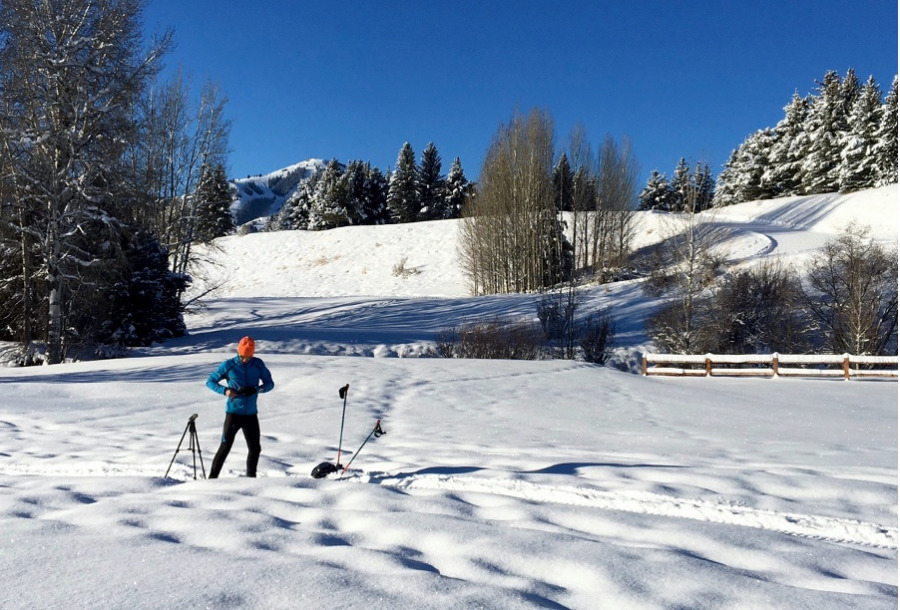 Bob setting up a tripod and phone for video capture along the trail.
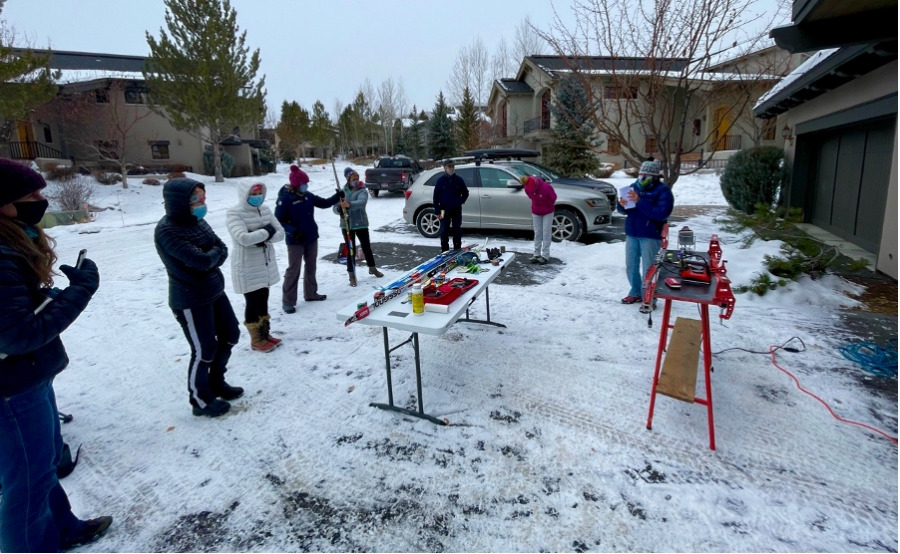 Betsy giving a kick waxing clinic in mid-December 2020 with full COVID compliance - outdoors, distanced, and masks. Key message: keep it simple and use binder!
With the competitive race season being very much diminished or canceled, the current situation presents a difficult environment for the competitive masters skier. Normally at this point in the season, one is focusing on one or two 'key' races along with a number of other races scheduled to assist with preparations for the 'A' races. But not this year - many races have been canceled or changed to a 'virtual' format and many skiers are casting about on what to do, skiing-wise, to fill the void. We too have been figuring out what might be productive and enjoyable substitute activities and foci for the 2020-2021 ski season and we present some of our ideas here.
One overarching approach is to look at those elements of skiing and ski racing that require long-term focus for improvement. Two of these are technique development and strength training. Outside of the training focus, another new direction is to devote some time to your local ski community and "give back" some of the support and guidance that we have all received from our respective ski communities.
The Season of Technique
One of the elements of cross country ski training that gets less attention than it should is technique development. Many master athletes will favor getting in their interval or aerobic development training sessions over spending quality time working on one's technique deficiencies. With the lack of competition opportunities, 2021 is a great year to focus on those technique areas where a skier needs improvement. Without an upcoming race, the need for peaking and tapering essentially goes away and interval sessions can be ‘downsized’ (but not removed!). This will leave a substantive amount of time and energy for technique development; and time is what it takes since proper technique development requires significant quantities of neuromuscular stimulus and the associated myelination (wiring) that will make efficient technique ‘automatic.’
An athlete can approach technique development in a number of ways. First is to engage with an experienced local ski coach who can conduct a thorough assessment of one's technique and provide guidance on what needs attention and how to work on these issues. The savings garnered from not traveling to race venues can be redirected to this activity.
Second, employ a 'do-it-yourself' approach. Technique analysis is best accomplished with video and masters skiers do far too little video analysis of their technique. One of the reasons that some of the youngsters you see out on the trail have such good technique is that they are not only getting direct, nearly-daily, coaching (as above) but they are also getting copious amounts of video feedback to help them hone in on the many nuances associated with the best cross country ski technique. Although one could employ a coach to do this (at a relatively high cost), we have found that having your own video set-up is very effective and efficient. It just takes the commitment to setting aside the time to do the video sessions.
Setting up your own video system is very straightforward - all you need is your phone, a tripod (as little as about $15 on Amazon), a 'phone bracket' for the tripod (most tripods come with these now), a remote for your phone (many tripods come with these now), and a ski trail (preferably groomed). Set up your video system in an appropriate place and ski by while taking video. You will be surprised at how 'bad' you look! Once you get over that disappointment, you can begin to work on 'fixing' some of the most obvious technique issues and document your progress along the way. It is very productive to closely watch and analyze any video footage from the World Cups that you can find - there is a lot available on YouTube, here at NTS, and other 'channels.' One effective tool is to put the World Cup or NTS YouTube frame up in one window on your computer and arrange the window from your video session alongside. Direct comparisons are a great way to see where your technique is lacking. Use this feedback loop along with additional video sessions to make targeted improvements in your technique - you'll be pleased as to how instructive and effective it can be.
Here’s a video introduction to ‘do it yourself’ technique video capture and analysis:
Here’s a sample field video:
Note: This sample video was panned by Betsy to gain more footage. The field of view of most phones/cameras will normally be sufficient to obtain sufficient and reliable technique video footage without panning so it is not essential to have a 'partner' helping.
Combining both of these approaches will lead to the best improvements - i.e. get some coaching and use that information to help you set-up and analyze your video sessions. As masters skiers, we generally don't have coaching all the time and it is important to have tools that will allow one to develop a 'feel' for good technique on snow. Once you have this 'feel' it is straightforward to execute upon an iterative improvement process to fine-tune technique nuances every time you ski.
Let the 2021 ski season be one where you make significant strides in technique development (pun intended). As you become more powerful and efficient your racing will improve and your enjoyment of the sport will increase significantly!
The Year of Strength
Strength, as we have indicated in numerous articles, is the foundation of good cross country skiing technique. Without requisite specific strength capacities, it is impossible to properly execute upon efficient, powerful cross country skiing. But not only is such specific strength capacity development one of the most commonly deficient aspects of training for the masters skier, it is also a very long-term process and requires an integrated multi-year development program to even begin to approach one's potential. Although aspects of muscle endurance are well accommodated within a "normal" structured training and racing program, the race season necessarily de-emphasizes any further development of power and max strength - two key elements in strength development for cross country skiing.
In a 'normal' year a well-designed training program will have periodized strength elements. Typically, after a month or so of recovery at the end of the prior racing season (often this is the month of April), strength training begins anew and follows a 'build- recovery-build' structure through about late November when an athlete will transition to a 'maintenance' strength protocol. Given that the competitive season this year is diminished or entirely absent, it is a potentially good time to engage with an increased strength focus this season. This means that one can include at least one more 3-4 week 'build' period in a training program (January or February). Given that, typically, an athlete will have about three 'build' strength periods in a given year, this will allow for a 33% increase in the strength-building segment of the current year program. The resulting improvements on-snow will be obvious and enjoyable! Include two additional 'builds' (January or February and March or April) and you have increased your focus on strength-building by 66% providing even further benefits across the board from technique improvements, power development, skiing efficiency, and injury prevention. It's another great way to make the best of the current situation.
Giving Back in 2021
Without a race season, it may be an opportune time to turn your focus from racing to giving back to your local Nordic community. While still able to train on our phenomenal trail system here is Sun Valley, we won’t be racing or traveling in the near future, which gives us more time for helping the local ski community. We are grateful to have had the many opportunities to enjoy Nordic skiing, and as we all know it is the perfect sport for athletes of all ages.
We encourage all racers to take a step back this season and look for ways to help others enjoy the sport we love. Not only is it rewarding to teach others, the process of distilling and explaining something often helps one to improve one’s own knowledge and skills. Each community is unique, therefore the opportunities to inspire will vary by locale and each individual’s attributes. Just imagine the power of the movement if everyone just did one small thing.
Some of the ways one can give back this season:
- Teach others – from friends to younger or older athletes reach out and lend a hand
- Share your favorite drills and workouts with others
- Give a wax clinic – show others all the wonders of waxing and fast skis
- Help with organizing a virtual event or time trial
- Be friendly on the trails – a smile or a wave can make someone’s day
- Make it a point to stop and chat with the 'elder' skiers (distanced of course) - you'll be surprised how important it is to them!
- Donate your lightly used gear and clothing
- Pick up trash or litter left by others
- Bake or cook a treat for someone
Well, these are a few ideas for making the best of the COVID-altered state that we all find ourselves in. We're certain that there are many others and we encourage everyone to take advantage of this time to do something productive and enjoyable in ways that will help you as both an athlete and as a person.