
Performance Decline, Dynapenia, and Why Plyometrics Are Critical for the Aging Athlete
by Betsy and Bob Youngman
Abstract
We have all been witness to our personal athletic performance declines as we age – our 10 km running times creep up, our place at the Birkie slowly sinks, or our perceived “snappiness” in training fades. It’s universal, affecting all athletes to varying degrees, but what is the origin of this decline?
In the following article, we explore age-associated athletic performance declines and the likely physiological causes. Some have surmised that these performance declines are due to a number of things happening while we age – the three primary ones being reduced VO2 max (aerobic capacity), loss of muscle mass (sarcopenia), and diminished recovery. Our research and personal experience indicate that very little of the performance decline is associated with a reduction in VO2 max or an inability to fully recover after training. We have found that sarcopenia is also playing a minor role but that age-associated muscle composition changes are the most likely primary cause for observed performance declines. Specifically, we find that preferential loss of Type II muscle and resultant peak power reduction (a.k.a. dynapenia) is the physiological process that is most consistent with observed age-associated athletic performance declines.
Based on the impacts of dynapenia on power generation, we suggest approaches for any athlete to slow down, stop, or potentially reverse sport-specific declining power. In addition to year-round strength training, central to this approach is the year-round integration of plyometric exercises into one’s training program.
Introduction
There are lots of things going on as we age - both physical and mental. On the physical side, an aging athlete will see a steady decline in performance, sometimes even with about the same training stimuli as when younger. Some will have diminished recovery, some will see significant reductions in VO2 max, some will experience increased injury rates, while others may perceive decreased power generation. On the mental side, an aging athlete will likely be dealing with a large spectrum of demands including a career, family, and other "big life” pressures. Often performance declines are a combination of these physical and mental changes. Even the best athletes will see their performance decline, although perhaps at a slower rate than for the other 99.5%. It is clear that there is something fundamental happening as we age that inhibits our abilities to perform in athletic events.
It has been proposed that the combined effects of reductions in VO2 max, diminished recovery, and loss of lean muscle mass (sarcopenia) are responsible for the bulk of observed performance declines in masters athletes.
Recently we covered the subject of diminished recovery in aging athletes,
and found that, although many masters athletes find diminished recovery, it likely has origins in high-stress levels outside of training. There is currently no well-documented physiological process that can explain the observed diminished recovery that many aging athletes feel. There are also masters athletes, however, that do not experience diminished recovery, and often, when investigated, it is found that these athletes appear to have managed to control (minimize) the levels of secondary physiologic stress (emotional & intellectual), that can make significant contributions to one's overall ability to recover from the primary physiologic stress of structured training. Clearly, the "net stress" any athlete is experiencing will have effects on one's ability to recover from training and grow as an athlete and, ultimately control one's ability to approach performance limits. But even with "optimized" stress management, an aging athlete will experience performance declines.
Declines in VO2 max have been proposed as a primary reason for observed performance declines, however, a critical look at the literature on this subject reveals that data to support this supposition is weak at best. Our experience is that, for athletes that engage with structured training that includes proper doses of high-intensity intervals, age-associated VO2 max declines from peak values as a young athlete (20-30 years of age) can be very small (5-10%) well into the 60+ years of age range. This magnitude of reduction is much smaller than the 1% per year (starting at age 30) that is often quoted. Although reduced VO2 max is likely playing a role in performance declines, it is not the controlling factor. For instance, a range of 5-10% difference in VO2 max is represented within the top 10 at every World Cup race, yet it is not controlling the winner of the race – the athlete with the highest VO2 max is not always the winner. The same holds true for masters competitors. An upcoming article will address this topic more fully.
Sarcopenia, although a large issue with the general population, is significantly less prevalent and occurs to a lesser degree in the masters athlete population in general. It is a very small factor for those athletes who incorporate year-round strength training in their training programs and therefore sarcopenia is not a primary cause of performance declines in these masters athletes.
The question then is: What are the causes of our diminished and decaying ability to perform as well as we did when younger? As will be expanded upon below, one singularly and extremely important factor is obvious: a decline in the ability to generate power. Power is the generation of force over distance (a.k.a. work) per unit time – simply, high power is a high force in short periods. As will be discussed here, power generation is critically important in all sports and plays a central role in cross country skiing. Each classic stride, double pole, and V1 or V2 push-off is entirely dependent upon one's ability to generate power - exerting high forces over a short period of time, e.g. exerting high force during the milliseconds-length periods of time during classic kicking, skating push-off, and double poling. Because of this reality, a focus on power generation is a primary part of all developing and elite athlete's training. However, it is safe to say that, by and large, power generation is not a common focus for masters skiers. As a result, power-focused training modes represent fertile ground for improvement for masters skiers. We hope that after reading this article you will have an increased appreciation for the importance of power development in your skiing and that you might consider adding power-building exercises into your training regimen. We are convinced that, if you do, you will see increased performance, efficiency, and enjoyment.
Performance Declines in Aging Athletes
Performance declines in aging athletes are well documented and have been analyzed by many authors over the past few decades. From a general perspective, these studies show masters age-group world records declining in an exponential fashion as a function of increasing age. The figure below shows the performance decline for long-distance track running events, where the data are normalized to the overall world record for the respective event. As can be seen from the graph, the world record 60-year-old athlete is about 25% slower than the overall world record holder in these events. This is a convenient factor to have in mind as it allows for comparison to elite-level performance for a masters athlete when in a race that includes elite-level athletes. Although there is no reliable way to collect comparable record times over specific distances in cross country skiing (due to the large influence of snow conditions and equipment choices), these track events (and the marathon) are likely the closest analog to the types of performance declines observed in cross country skiing.
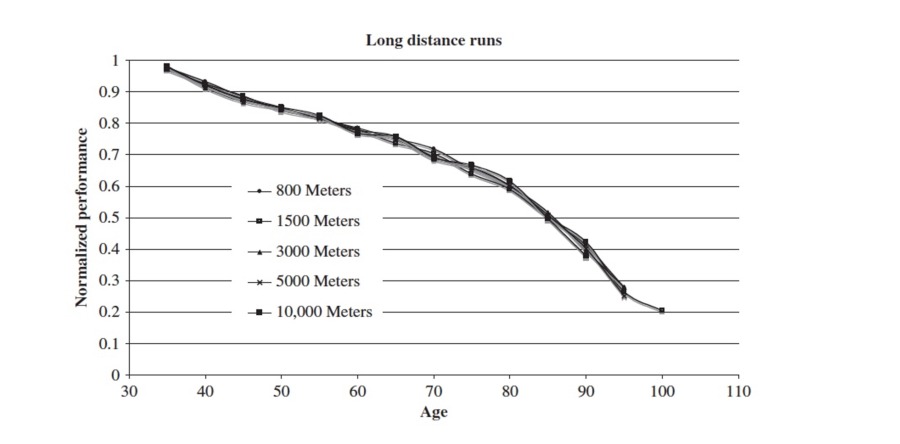
Fractional performance declines as a function of age for track running events. Data are masters world records normalized to the overall world record for the respective events. Taken from "Age-Associated Power Decline from Running, Jumping, and Throwing Male Masters World Records", P. Gava, et al., Experimental Aging Research, 41: 115–135, 2015.
When modeled, declines in track running events (as well as in many other sports), are found to exhibit exponential behavior leading to significant fall-off around 80 years of age. The figure below shows male and female performance declines indexed to the 30-year-old world record for a number of sports including non-endurance sports like weightlifting.
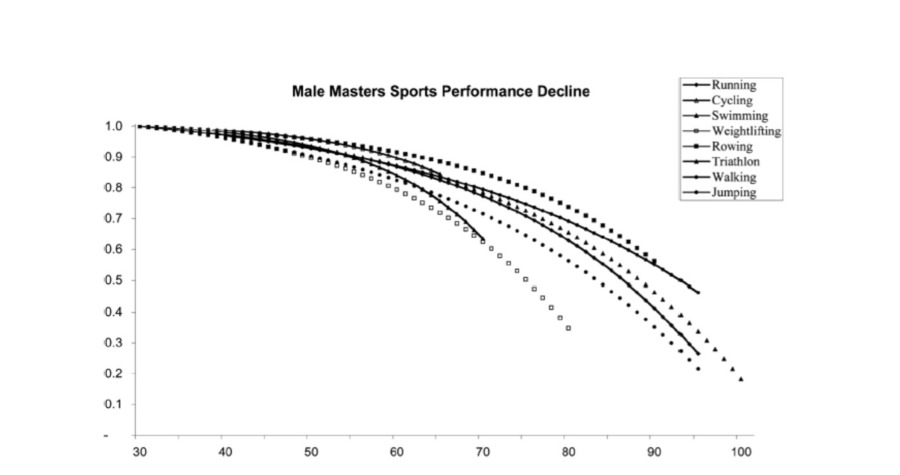
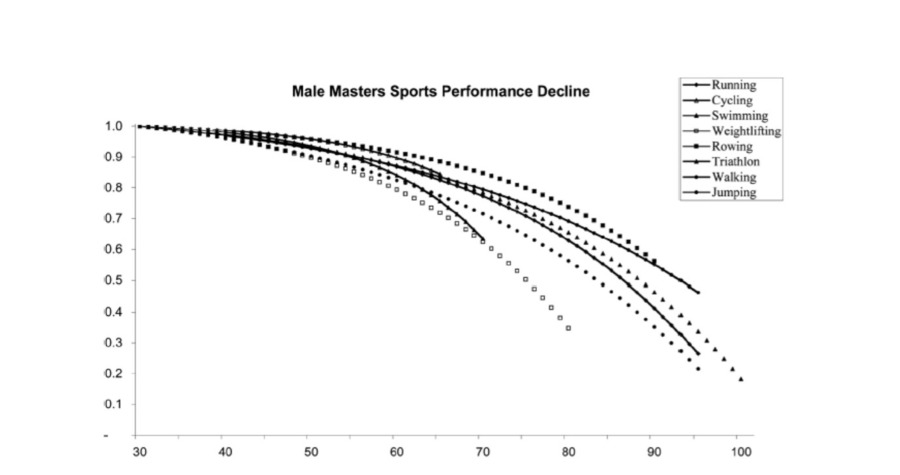
Male and female Masters fractional performance declines for a number of sports indexed to world record performances at 30 years of age (not the overall world record). All events within each sport are grouped for each age. Taken from: "Aging Performance for Masters Records in Athletics, Swimming, Rowing, Cycling, Triathlon, and Weightlifting, Experimental Aging Research, 36: 453–477, 2010.
The uniform observation of exponential decay in world-record performances in sports as different as running and weightlifting is indicative of a universal underlying physiological mechanism that is controlling the performance of masters athletes in all sports. This applies to aerobic and anaerobic-centric sports alike. The single aspect that all such sports have in common is peak power development and application of this generated power to the sports-specific movement. Although an Olympic lift takes place over a time frame of milliseconds to seconds and is highly anaerobic, the same peak power development occurs in cross country skiing in milliseconds on every stride or push-off and involves not just anaerobic energy systems but aerobic energy systems as well.
The peak power magnitude is different in each sport, with the anaerobic-centric sports exhibiting much higher peak power, but the common attribute of successful masters athletes in all of these sports is peak power development, not just aerobic capacity or anaerobic energy production. It is also important to point out that peak power development is directly correlated with average power output. As such it seems reasonable to posit that the reason we see performance declines as we age is due to a compromised ability to develop peak power, independent of what sport we actively engage with – be it a power-focused sport like weightlifting or an aerobic-focused sport like running, cycling, or cross country skiing. We'll examine what it takes to develop one's peak power capacity below, but a primary element in power development is shortening the time it takes to apply high forces, i.e. the ability to make rapid movements is central to peak power development.
It is commonly observed in masters athletes who train for cross country skiing, that strength training does not play the central role that it should. As well, peak power development plays an even smaller role in a typical masters athlete's training regimen. As will be discussed below, these two elements of training are the key training modes that will enable a masters skier to progress and to break through performance barriers that one might previously have thought to be unachievable.
Dynapenia and the Aging Athlete
Dynapenia is the loss of muscular strength and power as a function of age and appears to affect everyone to some degree. The following article provides a comprehensive summary of the disease and current understanding of origins and treatments:
Separate from sarcopenia (loss of lean muscle mass with age), dynapenia is a loss in the ability of muscle tissue to generate power. Power development is critical in the conduct of everyday activities like walking, getting up, and other functional movements requiring force generation in short time periods. It is a very important subject of study as dynapenia is likely the cause of the inability of many older individuals to perform regular functions critical to an active and healthy life. The ability to physically get up out of a chair or bed requires certain minimum levels of muscular strength and power development (force per unit time). It is found that virtually all aging individuals who have been studied utilizing both cross-sectional and longitudinal protocols, exhibit significant levels of decreased muscular strength and power. As a result, many aging individuals will require assistance in conducting normal daily movement functions such as getting up, walking, or preparing meals. It had been originally proposed that sarcopenia was the primary cause of the observed movement deficiencies. However, data do not support this theory as observed decreases in muscle strength and power are not well correlated with muscle mass loss. Therefore, dynapenia has become a primary focus of research into the causes of age-associated functional movement decreases.
The mechanisms leading to dynapenia are not fully established, however, it is clear that the likely primary causes are two-fold: neuromuscular deficiencies and skeletal muscle structural changes. Studies have shown (and are nicely summarized in this review article)
that there exists significant evidence for decreasing neuromuscular excitation of motor units (voluntary muscle activation) in aging populations. As well, age-associated increases of adipose tissue (fat) incorporation within muscle and structural muscle fiber changes including decreased Type II (fast-twitch) fiber numbers and size are consistently observed.
The above-referenced studies were conducted on broad populations of aging individuals that clearly do not contain many (or, possibly, any) masters athletes and therefore are most indicative of a relatively sedentary aging population. Data for active, competitive masters athletes could offer significant insight into the causes of and, potentially, treatments for dynapenia and we look forward to any such studies.
As outlined above, we do know that all athletes exhibit declines in performance with age in both endurance and power sports. In addition, the primary similarity between these diverse sports is the development of peak power and the application of this power to sport-specific movements. Therefore, it is clear that dynapenia is a likely primary contributor to the observed age-associated performance decline in sport. Realization of the detrimental effects of dynapenia on the performance of an aging athlete forms the basis for approaches to minimize the magnitude of performance loss as we age. The remainder of this article will address approaches that minimize loss.
Physiological Origins of Dynapenia
As described above, there are currently two proposed primary physiological origins to age-associated dynapenia: neuromuscular deficiencies and skeletal muscle structural changes (specifically, preferential loss of Type II (fast-twitch) muscle fiber).
Even in the absence of any neurological disease, neuromuscular deficiencies related to muscle strength and power, are observed in many aging populations. This is primarily attributed to disuse, i.e. a general lack of engagement with physical activity and specifically with activity challenges that target strength and power development. As will be discussed below, neuromuscular deficiencies can be straightforwardly addressed with properly designed progressive strength programs that can lead to significant improvements in neuromuscular function. Such strength programs are highly effective treatment pathways for those exhibiting dynapenia (and sarcopenia).
A significant body of evidence also exists that indicates that, as we age, while our Type I (slow-twitch) muscle fibers can, with proper training, maintain their number and size, our Type II (fast-twitch) muscle fibers reduce in both number and size:
Preferential loss of Type II muscle has direct impacts on strength and power since our Type II muscle is the primary muscle fiber type utilized in any motion that involves rapid high force generation. These motions include significant portions of our daily activities like getting up out of a chair, climbing stairs, and lifting objects. Of course, all sports involve rapid high force (i.e. high power) generation to varying degrees, and therefore any reduction in Type II muscle fiber number or size will adversely affect performance in sport. Here again, properly designed progressive strength and power programs can slow down such type II muscle loss and, in some cases, lead to Type II muscle growth (hypertrophy). With Type II muscle, the “use it or lose it” paradigm is central and plays a controlling role. We suggest here that the age-associated decline in Type II muscle is the primary cause of the performance declines summarized above.
The inclusion of regular strength and power exercise programs into our routines can significantly reduce the adverse effects of dynapenia (and sarcopenia) and lead to much more active lifestyles. For the masters athlete, similar (but more challenging) strength and power development programs will lead to increased performance in sport. There is no denying that progressive strength programs play a central role in sustainable active lifestyles for the general population and are critical for excellence in sports performance for masters athletes and recreational participants alike.
The Importance of Neuromuscular Stimuli and Associated Strength Programs for the Aging Athlete
In a recent review article:
the authors outline evidence supporting the assertion that neuromuscular deficiencies play a central role in the development and advancement of dynapenia in aging populations. This is primarily found to be due to a lack of engagement with challenging physical exercise within these populations. However, even among those individuals who regularly partake in vigorous exercise, declines, albeit of lower magnitude, are observed. This indicates that even regular engagement in sport is not sufficient to diminish the effects of dynapenia. The performance declines in world records as a function of age summarized above further support the notion that even the best aging athletes are subject to the ravages of dynapenia. A portion of the observed decline among these elite masters athletes is likely due to non-optimized training programs, some of which do not emphasize or even include, progressive general and sport-specific strength and power training. Realization of the positive (and essential) effects of strength training on one’s performance in masters sports events is slowly gaining traction across the world and, as a result, we expect that significant increases in masters performance will be observed in the coming decade.
Strength training (also known as resistance exercise training (RET)), has been shown to be highly effective in slowing down and, in some cases, reversing the effects of sarcopenia and dynapenia. In their review, Law, et al. document the substantial evidence of the efficacy of including progressive strength programs as a fundamental aspect of the lifestyle of a healthy aging human. Significant improvements in strength and power along with associated increases in physical function and activity level are direct outcomes of such strength programs.
As cross country skiing athletes, we know very well the importance of strength and power for success. The inclusion of general and sport-specific strength training in any training program has been emphasized by us as critical to advancing as a cross country skier (or as a runner, a cyclist, etc.). One of the central operating mechanisms in the utility of RET in increases in strength and power is neuromuscular in origin. In order for one to efficiently activate and fire muscle fibers, neuromuscular pathways, known as myelination, must be established and consistently utilized in repetitive exercises. Such repetitive work is also called “deep practice” and is thought to be fundamental to excellence in sport and other endeavors. The following video provides more background on myelination:
As we have reviewed previously, repeated activation of muscle fibers in a fashion exactly like (or similar to) those that we use in our sport is critical to becoming efficient in producing such sport-specific movements. The associated myelination that occurs during this practice will “hardwire” your muscular system to produce efficient motions. For example, try our “Herringbone Hell” workout:
One will quickly see how effective “deep practice” (and the associated myelination) is in taking your skill level to new heights. As Daniel Coyle, the author of the book “The Talent Code,” says in response to the old adage “Practice makes perfect” – it should be: “Practice makes myelin and myelin makes perfect.” The importance of challenging, repeated, practice of the fundamental movements in one’s sport should not be underestimated.
Plyometrics and Power Development
Skill is not the only thing that is developed when engaging with “deep practice” – power development is also improved. This is because the two are intimately linked since the skill (firing muscles in the correct order, over the correct time periods, and in the correct position) will produce the highest force generation in the shortest time period relevant to the motion. Being able to produce the highest force is the first step in further developing one’s power in sport-specific movements. Without skill, any further power development can be wasted in inefficient application to movement. Skill and power are inexorably tied together and must be developed together. Plyometric exercises (repeated dynamic and explosive sport-specific motions) are, far and away, the best modality to effectively develop both skill and power in a controlled and progressive manner. These exercises address both neuromuscular development and type II muscle growth stimulus that are critical to performance excellence as a masters skier.
In addition to reduced or minimal strength training as compared to younger and elite athletes, masters athletes also tend to not include plyometrics in their training programs. Plyometrics are a fundamental part of training for elite athletes in all sports, and particularly for cross country skiers. The development of increased power in sport-specific movements requires not just RET, but rapid sport-specific and challenging plyometric exercises that assist in myelination and develop one’s ability to efficiently generate high levels of specific power.
What is Plyometrics?
Plyometrics are strength exercises aimed at the development of instantaneous power in highly dynamic movements. Plyometric exercises are typified by the “box jump” where one jumps up onto a box in one two-legged or one-legged leap. This requires the development of high power (high work (force X distance) over a short duration) in order to enable one to lift their body weight up some distance into the air and onto the box. Because of the short (millisecond) timeframe over which work is conducted, these exercises elicit the recruitment of primarily Type II (fast-twitch) muscle fibers. The development of such high power capacities is important in many of the fundamental movements in cross country skiing such as “kick” in classic skiing, “push-off” in freestyle, and classic double poling. In addition to the use and development of Type II fibers, the “stabilizer” muscle systems are also developed. These small muscle groups are the origin of good balance and are essential in proper skiing technique and skiing economy.
The neuromuscular adaptations (myelination) associated with the specific movements while engaging with plyometrics are critical to development of efficient movement. This is why it is important to design exercises that replicate or mimic the motions and balance that are utilized in cross country skiing. Studies have shown that incorporation of regular plyometric sessions results in increased economy in distance running:
The utilization of plyometrics for training has long been applied in cross country skiing since the same types of movement and application of impulse forces is occurring. Although more difficult to measure analytically, skiing economy is observed to increase when athletes include consistent plyometric training in their programs.
The neuromuscular adaptations from plyometric exercises enable high instantaneous power and associated coordinated timing that lead to very efficient power delivery on snow and therefore positively affect skiing efficiency. The associated Type II muscle growth stimulus inherent in engaging with plyometric exercises provides the ability for an athlete to take full advantage of these neuromuscular adaptations and maximize power production.
As a result of these adaptations, properly designed plyometric exercises provide a “triple whammy” training stimulus (strength/power development, balance development, and economy development) that, on a minute-for-minute comparison with other training modes, is a very efficient spend of training time.
The concept that a masters athlete would actively engage with rapid, explosive, and challenging exercises on a regular basis has been dismissed by many masters coaches and athletes as “inappropriate”, “too risky”, “too challenging”, or “asking for injury”. Such admonitions have lead to a situation where an overwhelming majority of masters skiers do not include plyometrics in their training programs even though these exercises represent one the most important and efficient elements of training for competitive cross country skiing.
Arguments against the inclusion of plyometrics in training programs for masters skiers include concerns over high connective tissue stress, over-reaching, and potential for falls (or other missteps), each of which could lead to injury. Although these are all valid concerns, it is straightforward to design and execute upon plyometric exercise programs that minimize the potential for occurrence of any of these concerns. Rather than setting aside the entire concept of utilizing plyometrics for masters athletes, we suggest that it will be most productive if an athlete were to include such exercises in a progressive way under the supervision of a strength and conditioning professional. The key part of this approach is to be progressive and to not proceed with increased intensity and volume at too fast a rate. This is true for any strength program but is critical for plyometric programs due to the high muscle and joint stress typically experienced during the execution of the exercises.
Our experience is that the inclusion of a rigorous plyometric exercise program along with aerobic and strength training is very approachable for the vast majority of masters athletes. The benefits of the targeted development of power, balance, and efficiency in sport-specific motions provided by plyometrics will be obvious even after just four weeks of execution upon a well-designed progressive program. We highly recommend considering the addition of plyometrics to one’s weekly training but to do so with the assistance of a strength and conditioning professional familiar with the implementation of plyometrics.

An early season (October 11) 4” snowstorm doesn’t deter the masters athletes in Betsy’s and EJ’s Fall Dryland training group here in Sun Valley. Uphill bounding with poles, shown here, is an excellent, relatively low impact, sport-specific plyometric exercise with big benefits for fitness, power, and technique. It’s also dog-friendly!
Plyometric exercises that are typically used for cross country ski training include box jumps, single and two-legged hops, hill bounding with or without poles, “skiers lunge”, and “lunge-ups” among many others. A good resource is this book:
We have provided examples of plyometric exercises for master skiers previously and we include links below to three short videos that we put together outlining two such exercises. There are many others and they can all be approached in a progressive and safe manner.
Plyometrics Introduction, “Box” Jumps and “Hops”:
Summary
The observed performance declines in athletic performance as a function of age have a common origin, independent of the specific sport. The common origin is age-associated decreased power development in sport-specific motions. Such loss of muscular power is called dynapenia and is a disease that appears to affect everyone to some degree.
It has been found that dynapenia is likely caused by age-associated neuromuscular deficiencies and preferential loss of Type II muscle. Studies have shown that engagement with structured resistance exercise training (a.k.a. strength training) is central to slowing down, stopping, or possibly reversing the detrimental effects of the disease.
For the masters athlete, the inclusion of plyometric exercises into one’s training program provides targeted, highly functional training stimuli that directly address the primary causes of dynapenia and the associated declines in athletic performance. The use of progressive, properly designed, plyometric exercises will lead to increases in athletic performance, including more powerful sport-specific motions, superior balance, and increased economy. Additionally, these exercises will help with injury prevention and general physical durability.
We highly recommend including plyometrics into your regular training – not just for sport, but for your active life!