
Mental Strength Training for Coaches Part 1: Why coaches need mental strength training, too
By Ryan Sederquist,
Dr. Brian Zuleger, professor of sport psychology at Adams State University and certified mental strength coach for the legendary cross country and track and field programs, echoed these statements in his 2021 Mental Toughness Training virtual seminar for track and field coaches this spring. “Coaches are under a lot of pressure - perceived or real - and it impacts how they behave in key moments,” he outlines. Thankfully, most of our jobs aren’t life or death situations. Zuleger warned coaches to not equate their position with an Urban Meyer or similar NCAA or
Introduction
You realize mental strength training is a critical ingredient to maximizing performance. The next step: make sure your athletes are exposed to and grow in their mental strength, right? Well, yes … and no.
Dr. Rick McGuire, a longtime track and field coach and certified mental performance consultant, believes, “Sport psychology should be delivered to and through the coach.”
Even if you are fortunate enough to add a new position to your staff - a certified mental strength coach - you are still going to be the primary mouthpiece to your athletes. A more plausible scenario, however, would be that you are going to need to do the research AND implementation primarily on your own.
If the motivation of your athletes being more equipped to go into battle - now and for a lifetime - isn’t enough, then the fact that mental strength training could also change your life as a coach, should.
“….Didn’t only change my coaching - changed my life.”
A 2019 study out of West Virginia University examined the experiences of eight high-performance coaches who worked with a sport psychology consultant (SPC) for their own performance enhancement as coaches (Sheehy, Zizzi, & Dieffenbach, 2019). Coaches felt they received many benefits: facilitation of self-awareness, performance enhancement, enhancing interactions, and friendship development.
Aspects of both their coaching and their home life were improved. “She (the SPC) gave me perspective on what was important and didn’t only change my coaching, changed my life, changed the way I look at things,” said a participant. “[There is a] lot to be said about you keeping a healthy work perspective because it leads to a lot of stress, a lot of burnout, a lot of dark times,” another participant said.
Dr. Brian Zuleger, professor of sport psychology at Adams State University and certified mental strength coach for the legendary cross country and track and field programs, echoed these statements in his 2021 Mental Toughness Training virtual seminar for track and field coaches this spring. “Coaches are under a lot of pressure - perceived or real - and it impacts how they behave in key moments,” he outlines. Thankfully, most of our jobs aren’t life or death situations. Zuleger warned coaches to not equate their position with an Urban Meyer or similar NCAA or
NFL head coaching role, where job security is rare and the spotlight is bright. It is foolish to mentally set a similar stage in our minds, as it can directly impact how we handle those high - or even low - pressure situations. Regardless of whether or not one actually is in a highly competitive coaching market where concerns of job security or more directly related to performance outcomes on the pitch, it is a good reminder for coaches to find foundational stability in who they are outside of coaching. This security enables a coach to weather any types of external factors which often bleed into their mental state and therefore actual interactions.
In his seminar, available here, Zuleger elaborates on the idea of coaches addressing their mental demands as being paramount to coach and athlete well being, coach-athlete relationships, and athlete training and recovery.
Research suggests coaches are under a tremendous amount of stress (Fletcher and Scott, 2010; Olusoga et al., 2009), and as Frey (2007) puts it, are “problem solvers” with problems of their own.
“Coaches are people first and coaches second,” Zuleger stated in the talk.
This means they have the same physical and psychological needs that others have. If they aren’t met, performance is compromised. And, “Coaching is a performance,” Zuleger says.
If they aren’t in a good “head space,” their ability to navigate the performance is no different than an mentally unstable athlete trying to address the psychological and emotional demands of their game or race. Sport psychology educator and author, Ralph Vernacchia, who also coached multiple All-Americans during a decades-long stint as cross country and track coach at Western Washington University, once said, “The endeavor that excites us the most, exhausts us the most.” If you went into coaching, this statement likely applies to you. Coaches must recognize this fact, knowing our tendency to be everything to all people can make us susceptible to burnout. If your glass is empty, you won’t be able to behave appropriately when the stakes are high and the temperature is turned up.
In competitive situations, coaches are making decisions in the heat of the moment, being asked to exert themselves (quite a bit physically when it comes to cross country skiing), and are tasked with communicating vital information to athletes as well as providing them with mental and physical support. Furthermore, like athletes, they are reacting to what is transpiring. It turns out, their reactions can have a direct impact on athletes - both in the moment and long term.
“Athletes mention that coaches who fail to model good behavior have an impact on them,” Zuleger stated during the lecture in summarizing recent research.
It makes sense - social learning theory suggests we learn by watching. Your toddler holds his spoon like you because he watched you. He learned the cuss word from hearing you argue in the kitchen, too. Coaches who are ill-prepared for high stress situations, thereby displaying lack of composure and consequently decreased performance, beget athletes who are highly anxious and inevitably do the same when they are placed in the fire (Mottaghi, Atarodi, & Rohani, 2013; “The relationship between Coaches’ and Athletes’ Competitive Anxiety and their Performance.”)
“By applying mental training to themselves, coaches can learn to better model the behaviors and skills they desire the athletes to exhibit.”
Sheehy et. al (2019) also demonstrated that a mental strength coach’s involvement alongside a program not only affects the athletes directly, but also the coaches directly (and thus, in a way, the athletes indirectly as well).
It’s probably easy to imagine a red-faced Bobby Knight throwing a chair onto the basketball court in a fit of rage and placing a “correct” response to the frustration he likely felt in that moment. How do we apply this to nordic skiing and other endurance sports, though?
I think the primary theme here is confidence. A calm coach who speaks with a confident tone of voice in explaining the purpose of each day’s workouts instills confidence in the athlete that he knows what he is doing and they have a valid reason to trust in their training. In the competitive sphere, the result is an athlete who approaches the starting line with confidence in their fitness and their consistent accumulation of physical stimulus and adaptation.
I recall an experience where I observed a head coach from the position of volunteer assistant coach for three seasons. He was very unstable in his communication with athletes - both about workouts and about the standards necessary to race on the varsity team from week to week. It became confusing for athletes and no doubt added an additional piece of stress to their plate. If we consider every item - physical and mental - to have the capacity to reduce the amount of ‘water’ in our proverbial glass, of which we want to keep as full as possible going into a competitive situation, we must be fully cognizant of our potential as coaches to spill our athletes’ cups with our own actions, words, and behaviors.
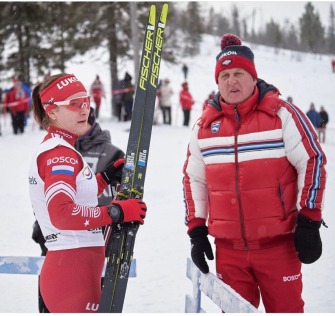
Bringing this into the actual arena, my suggestion for coaches is to think about how their demeanor can positively or negatively impact athletes when it comes to ski and wax selection. The ripple effect of a coaches’ words or body language when it comes to ski speed as they hand over the racing planks to an athlete often makes or breaks their day.
On the flip side, at the end of competition, how a coach handles defeat and victory can either keep a team swimming strongly in the right direction, or sinking in the midst of a storm. Coaches need to have a calming effect on athletes - even when they (the athletes) are losing their cool. Again, not only will this help them perform, but it is your duty as a coach - a teacher - to raise up your athletes in the way they should go by modeling proper behavior to them.
“As adversity and challenges arise, if you are able to adapt and be flexible and adjust, that’s going to help your athletes learn those skills, and that’s what you want at the end of the day,” says Zuleger.
“It helps you and it helps your athletes.”
The only way to get there is to manage well-being and intentionally strive for individual growth and self-reflection in the areas of mental strength. Check back for our third article in this mental strength training series, “Mental Strength Training for Coaches, Part 2: Well being - suggestions for coaches.”