
Training foR long Distance skiing - Part 1
By Ryan Sederquist
Part 1 of “Training for Long Distance Skiing”
2021 Study on the training characteristics of Visma Ski Classics SkiersA Feb. 2021 original research article that analyzed the training characteristics of twelve world-class Visma Ski Classics athletes is the focus of our first article in a three-part series on training for loppet racing. While it seems most recreational American skiers have a tendency to focus on skate ski races, the classic marathon is the foundational event to all ski racing, dating back to the late 19th and early 20th centuries. Russia lays a particularly rich claim on the history. Dr. William Frank’s book Everyone to Skis! cites a mass participation race from Nizhnii Novgorod to Moscow in 1936 - a 437-kilometer trek - which attracted sixty thousand participants. In the 20s and 30s, various teams in Russia were known for racing across different parts of the country, often at distances ranging from 2000-8,000 miles! Frank writes, “Soviet interest in long-distance skiing was codified in a number of traditional ski races. A yearly 60-kilmeter race began as early as 1922. Moscow’s annual 100-kilometer Great Race, consisting of five loops around a 20-kilometer course, had its initial run in 1938, as did a four-day stage event on the Iaroslavl to Moscow route.”
Recently, the Visma Ski Classics has grown in popularity, and thanks to creative programming, efficient media coverage, and the emergence of new stars and former World Cup athletes joining the circuit, it is becoming increasingly the ski league of choice to track for casual fans. In those events, the top athletes exclusively double-pole all of the races, no matter the distance or the climb.
How do they train to do this? Could you train and race using primarily the double-pole technique? Perhaps reading this will have you reconsidering your strategy, reconfiguring your wax box, or ….throwing both out altogether and grabbing a pair of double-pole skis.
Introduction to research
Here are some key points - summarized in my own words - from previous research which funneled the current authors into their proposed gap in the literature:
>The VSC athletes race 40-90km in distance and use exclusively the double pole (A recent study conducted on the Vasaloppet showed that 98 out of the top 100 skiers used DP)
>In order to do this, well-developed DP technique and upper-body strength and endurance are necessary.
>VSC skiers are more efficient at DP than World Cup skiers > When comparing VSC and Olympic skiers in DP capacity, the time to exhaustion was similar, but VSC skiers had lower peak oxygen uptake and better skiing efficiency (lower O2 cost) than Olympic skiers. VSC skiers were previously reported to perform better in DP on uphills than Olympic skiers and have lower blood lactate concentration, heart rate, and rating of perceived exhaustion at submaximal workloads due to higher DP efficiency.
>Only one report exists on the training of VSC skiers. It reported that skiers have:
- 775 annual hours
- Intensity distribution: 83% LIT, 3% MIT, 6% HIT, 2% speed, 7% strength
>This report compares to reports on Olympic skiers, which says they do:
- 750-950 annual hours
- Intensity distribution: 90-95% endurance training (88-91% LIT, 3-7% MIT, and 4-6% HIT, with equal classic and skate focus) 5-10% strength training, and 1-2% speed training
>The level of detail in analyzing the VSC training methods is lacking. This study aims to address this by investigating volume, intensity, modalities, and specific session designs
Methods
Participants: 12 Norwegian and Swedish athletes who participated in the VSC for at least three years and had achieved at least two podium places during their career. Together, they amassed 154 podiums; seven also had podiums in the FIS World Cup.
Timeframe of data collection: May - September 2020
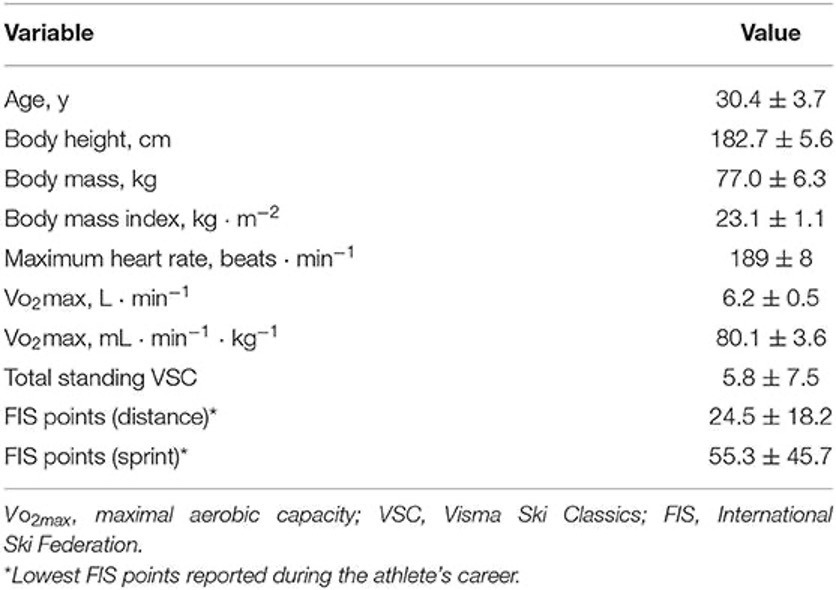
Participant Characteristics:
Questionnaire
A 93-question survey was used to collect information about the athletes’ training characteristics and performances during their most successful VSC season. They also shared detailed designs of typical training sessions used to meet the demands of the VSC races.
Training Data Terms
Training data was organized into periods:
GP - General Preparation Period (May-August)
SP - Specific Preparation Period (September - November)
CP - Competition Period (December - April)
Training was also organized into intensity:
LIT - below the first lactate threshold (<2mM blood lactate, 60-82% of maxHR)
MIT - between first and second lactate threshold (2-4 mM blood lactate, 82-87% maxHR)
HIT - above second lactate threshold (>4 mM blood lactate; >87% of maxHR)
Strength training = heavy strength training and core stabilization
Speed training = max efforts of 10-20 second sprints or series of 10-15 plyometric jumps using ski-specific movements
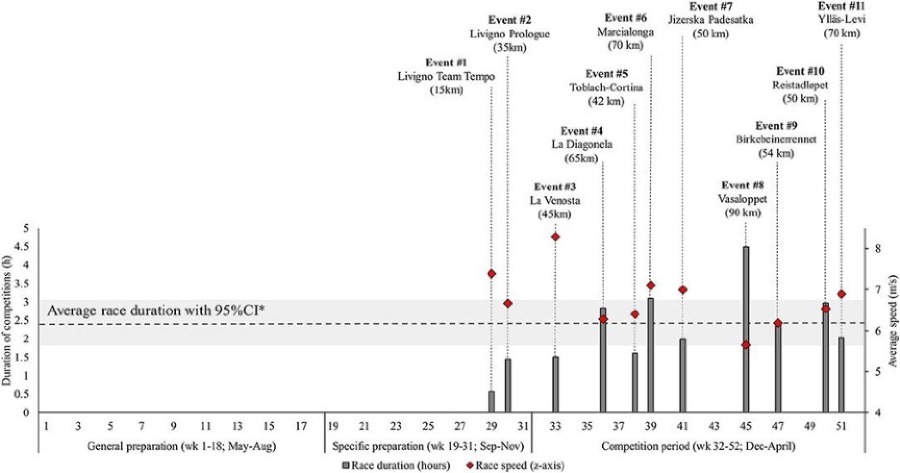
Illustration of the annual cycle in long-distance XC skiing with the timing of the competitions in the Visma Ski Classic 2019. Competition duration and speed are calculated based on the average for the three best skiers in each race and the course length reported in the official result lists (www.vismaskiclassics.com) of the 2018–2020 seasons. *The Livigno Team Tempo is excluded from the calculation of average race duration (dotted line) with 95% CI (gray area).
Results
- Training volume: 861+/- 90 hours
- Distribution: 92% endurance training, 6% strength training, 2% speed training
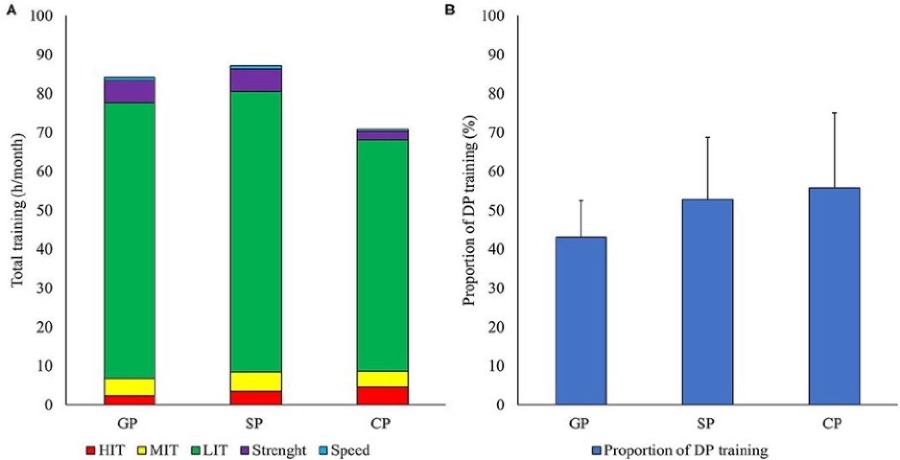
- Intensity Distribution: 88.7% LIT, 6.4% MIT, 4.8% HIT
- 50-60% of endurance and speed training was performed using the DP (and usage of DP dramatically increased in SP and CP compared to GP)
- Training was comprised of many long-distance sessions, typically a daily 3-5 hour session.
Training distribution (A) across the annual period [general preparation period (GP: May–August), specific preparation period (SP: September–November), and competition period (CP: December–April) during the athletes' most successful seasons distributed as endurance [low- [LIT], moderate- [MIT], and high-intensity [HIT]], strength, and speed training, as well as the proportion of training using the double poling (DP) subtechnique (B) for world-class long-distance cross-country skiers.
Other results of note:
- Athletes kept their volumes fairly even week-to-week. Microcycles = 20-25 hr/week for three weeks followed by a lower training load every third or fourth week.
- May and June are the “off” months
- Five skiers reported blocks with emphasis on specific qualities during the GP
- Three skiers included blocks of strength training
- One skier used a HIT block which included 5 HIT sessions in 6 days (based on a recent podcast, I believe it’s possible this is Tord Asle Gjerdalen...but, who is speculating….)
- All skiers had more accurate and structured intensity control during SP than GP, which was maintained during CP.
- Competition schedule affected training volume during CP; 10-12 hr/week during race weeks and 20-30 hr/week when no races were held.
- Strength and Speed training: Athletes kept speed training going all year. They had higher strength training volumes during the GP(5.8 hr/month) and SP (5.7 hr/month) compared to CP (2.1 hr/month)
Exercise Modes
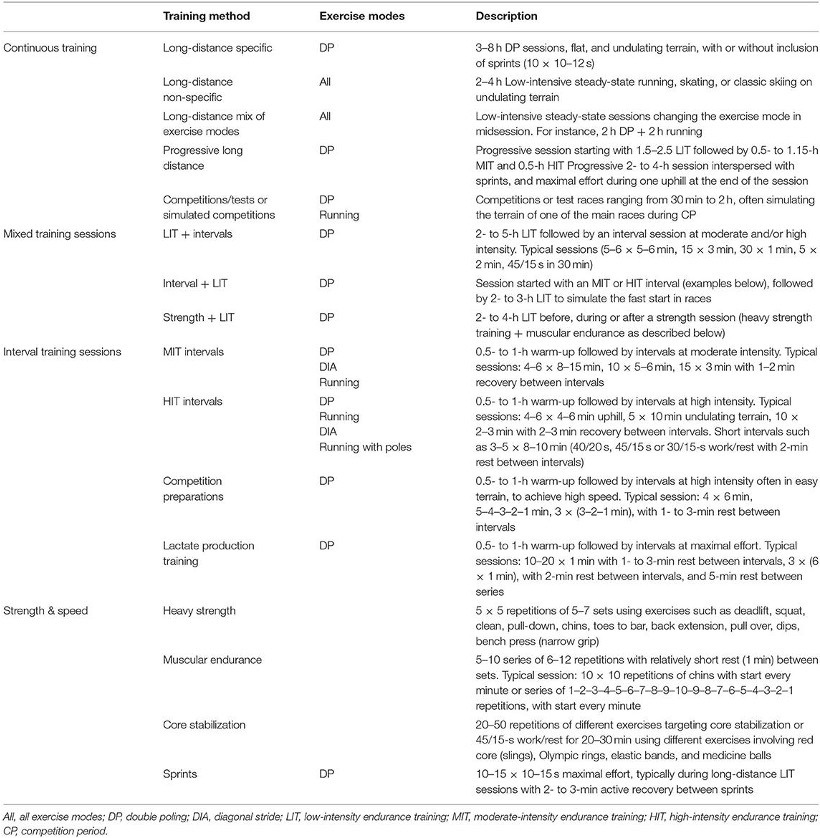
Sport-specific training methods for long-distance XC skiing, categorized as continuous, mixed, and interval-based training sessions.
Representative training week examples through the annual season for long-distance cross-country skiers.
Discussion/Points to Ponder
- The mean race intensity in a long distance ski race is 82% of maxHR. Long duration MIT sessions performed with DP are common among VSC skiers.. MIT sessions are prioritized in VSC skiers, with longer intervals. 8-15 minutes with 1-2 minutes rest is common, as are continuous 45-75 minute sessions.
- Athletes design MIT/HIT workouts to simulate the race stresses and prepare for unique course demands. Workouts like the Vasalopp-pass (a 4-5 hour session with a set of intervals or threshold bouts intermittently dispersed in the middle) were designed for such a reason. Other examples include:
- 1 hr of MIT + 2 hr LIT + 30-40 min HIT
- 2-4 hr LIT + 15 min HIT on steep uphill > used to target the Marcialonga, which ends with a steep uphill
- HIT sessions performed to increase general aerobic capacity were performed in various modes - striding, running, or running with poles
- Athletes used a traditional periodization model - “emphasizes mixed focus on training forms and intensities during all periods across the annual season, but with a progressive reduction in training volume substituted by higher training intensity and more specific training toward the CP.”
- The proportion of endurance training that is performed using the DP is startling when compared to Olympic skiers. VSC athletes execute 50-60% of endurance training using DP whereas Olympic athletes execute 50-60% in 4-6 subtechniques of two disciplines. VSC athletes DP 400-450 hr/year, more than double the volume of Olympic skiers, according to the study.
- A 2005 study (Calbet, J. A., Holmberg, H. C., Rosdahl, H., van Hall, G., Jensen-Urstad, M., and Saltin, B. (2005). Why do arms extract less oxygen than legs during exercise? Am. J. Physiol.-Regul. Integr. Comp. Physiol. 289, R1448–R1458.) showed that O2 extraction in the upper body of cross-country skiers is close to that of the legs. In the case of VSC athletes who conduct such a high volume of upper body training, it is possible that O2 extraction for them is even higher.
- Some athletes performed DP sessions which lasted 8 hours. Here is a quote from a participant that should be allowed to simmer in our minds: “It is also a question of how much DP you can endure, without having motivational problems, injuries, or other setbacks.”
- Strength training has the purpose of injury prevention (“being strong enough” to tolerate the high volume of DP in the ensuing periods, according to one participant) and also structural/biomechanic strength directly related to the DP technique. They need the muscles required for good form to be strong, and they target those muscles with specific exercises.
- Speed training is incorporated into LIT sessions in 10-20 second bursts in order to simulate attacks or positioning in a final sprint to the finish line. The researchers suggest that, based on training data and self-reported sprint ability, VSC athletes may have “unused potential to further develop their speed systematically.”
Further research:
If this study piqued your interest, check out these other articles relating to long-distance skiing:
Considerations for Training for the DP - lactate threshold study
What’s the difference between World Cup and Visma athletes? Comparison of DP form in WC and VSC athletes
Uphills are important - here is the latest research on what happens on uphills