Skate Ski glide testing 101
Skate Ski Test 101
By Andy Newell
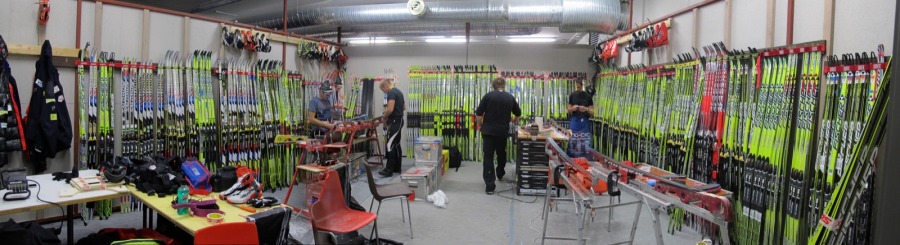
Whether you are testing a fleet of 6 or more skis the day before the race or just a couple pair, there are some basic fundamentals that will make for a productive test. Before you start testing on the days leading up to your big competition it helps to have a diverse fleet of skis and some prior knowledge of what kind of grinds and flexes work in certain conditions. The best folks to assist in this process are Caldwell Sport and Boulder Nordic, both of whom can provide insight on ski selection and grinds.
When I say diverse fleet I don’t want to give the impression a skier needs A LOT of skis. Less is often more, but it does make sense to cover your bases by ensuring you have skis for a variety of conditions. In my opinion it makes sense to have at least one ski designed for the following conditions in both skate and classic. Cold Hard, Cold Soft, Universal, Warm Hard, and Warm Soft.
Most racers will agree it’s better to have a spectrum of conditions covered rather than a few skis that are extremely similar in grind and flex. If you have a pair of skis that are fastest in a specific condition look to diversify your fleet by trading, selling, or changing grinds on the skis that never quite match up. By just trying to cover the 5 conditions I mentioned above (Cold Hard, Cold Soft, Universal, Warm Hard, Warm Soft) you should be able to keep things pretty simple and look to designate a pair to each condition.
From the comfort of your garage this makes selecting a ski for race day pretty straight forward right? In the real World however, snow can be a little bit more temperamental than just 5 conditions. Sometimes snow is cold and just semi-soft, or universal and warming, or frim but breaking down, sugary but sunny out,… you get the point. So more often than not it makes sense to select a few pairs for a ski test on the race track. Below are some guidelines and hints to help keep the testing process consistent and productive
Zero your skis: This means make sure each pair has the same type of glide wax on them before testing. I recommend using a cold NF glide wax like an PS6 or TOKO blue. When preparing your skis before the test try to keep it as consistent as possible between each pair. For example, try to brush out each ski approximately the same way.
Also pay attention to how much you ski on each pair. Some snow, such as warm dirty conditions, can considerably slow down a ski the more kilometers you log so don’t expect to ski several km's on one pair, switch to another and perform an accurate ski test between the two.
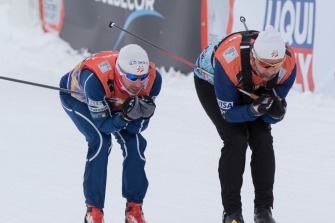
To glide or not to glide: It’s easier to execute accurate glide-outs in some conditions than others. Wind for example = not accurate. Quickly changing snow conditions like a track in direct sunlight = not accurate. In my opinion doing single person glide-outs such as tucking down a small hill and marking the distance of each glide is very rarely an accurate way to test. If you can grab another skier and perform some side by side glide-outs it will test the actual speed of each base more accurately.
To perform a side by side glide out double-pole into a straight downhill next to your partner and drop into a balanced tuck next to one another. Hold onto each other’s hand or pole for a few seconds to stabilize and match speeds, then let go and see if one pair glides away from the other. Chances are one skier is a little heavier than the other so swap pairs and repeat the test making sure to keep each skier on the same side of the trail and note the difference in speed, especially during the side by side gliding portion of the test.
Side by side glide-outs are more accurate because it can give us a better indication of the ski gliding ‘at speed’ rather than slowly inching to a halt and marking a distance. Slowly inching along the snow is typically not accurate because finer grinds will often skootch along the snow better than bigger grinds at these very slow speeds but that doesn’t give a good indication of which base is better at your actual racing speed.
Test by feel: Sometimes accurate glide-outs are just not possible and even if they are it is never a good idea to pick a ski entirely on glide-out speed. If our ski races were just tucking, maybe, but in skate skiing we need push off of our skis too! Here are some pointers to help you test a ski by feel.
- Testing ‘one and one’ (different ski on each foot) can be a good way to compare skis on different terrain. Remember that some grinds will feel better a slow speed (uphill V1) and others will feel better on downhills or V2. We are looking for the best all-around speed. Remember to switch skis and feet often (its common for people to have one foot that might always feel better than the other). Skating without poles and stepping from one foot to the other on a gradual downhill is a good way to feel gliding speed.
- Don’t undervalue a ski that has a strong feeling push. Remember to try each ski at race pace and practice pushing hard onto the skis. This is how we feel out the flex of the ski and determine which flex is best for the condition. In hard packed snow if you feel the tip of your ski slide laterally or move slightly as you push, chances are the ski is not stiff enough for the condition. If snow conditions are soft and you feel pressure or a plowing sensation on the front third of your ski, likely the flex it too stiff for the conditions. In my opinion the feel of how a skate ski pushes is as or more important than the maximin glide speed.