
ORTHOTICS FOR CLASSIC BOOTS
By Kurt Jepson
Last month we looked at orthotic characteristics and applications specific to skate boots. A review of that article is recommended to preface this discussion on implementing corrective devices into classic boots.
As with skate specific orthotics, the athlete or clinician, must first classify the foot as “uncompensated” (under pronator/retains components of supination), “compensated” (pronates with ease), or “neutral” (pronates appropriately) prior to fitting. Performing the Wet Test, examining the callous pattern on the sole of the foot, and noting shoe wear patterns provide a basic clinical picture of what the foot is doing functionally. Correction focuses on blocking excessive motion lending to instability and/or encouraging efficient foot and ankle postures.
Functional foot types below;
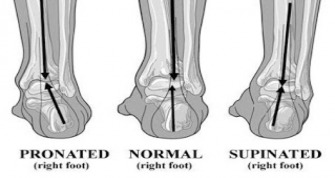
When selecting foot appliances for classic skiing there are variables to considered not associated with skating.
The most obvious is the directional impulse to the snow in late glide to provide propulsion. In classic skiing this vector is produced inferiorly, while in skating it is directed laterally. Second, the platform from which this force vector is transferred, is uniformly stiff throughout the length of the foot in skating but must include a forefoot flex point in classic skiing. Lastly, there are considerations regarding inherent First Ray (“Big Toe”) position and function. These will all need to be addressed in the classic boot orthotic.
For this discussion, First Ray postural classification can be divided into categories of; “Plantar flexed and rigid”, “Plantar flexed and mobile” or “neutral” positioning. A Plantar flexed position describes the downward inclination of the big toe when relaxed and non- weight bearing (prone) as viewed from the rear of the foot. The toe position is assessed as it relates to the plane of the second through fifth toes. If present, the large toe`s available motion must be further categorized as fixed, rigid, or freely mobile in the dorsal direction.
This is simply done via passively moving the toe up and down, noting its ease of displacement.
Plantar flexed first ray below;
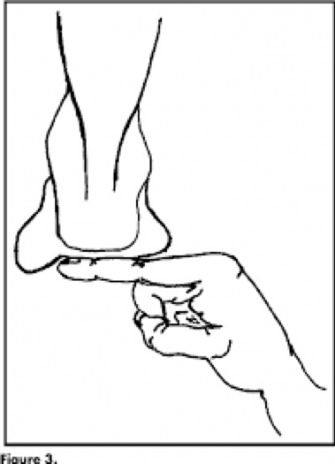
Below; Assessing mobility of a Plantar flexed first ray.
A. fully mobile/”hypermobile”. B. mobile to neutral. C. Rigid/ “hypomobile”.
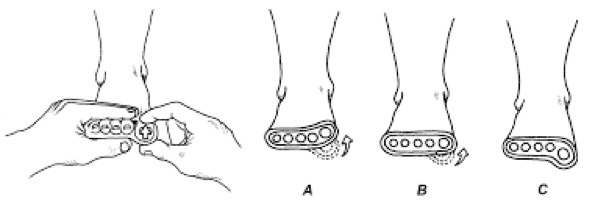
Presence of excessive, thick callous under the big and little/5th toe may be noted on all feet depicted above, but particularly on foot B and C. Well defined callous on the heel, under the little and big toe is referred to as a “Tripod pattern” and associated with first ray malposition and uncompensated feet (under pronators). The retention of supination (rigid foot/ankle position) through skiing movements makes it difficult for the skier to engage the ski properly for kick or find a flat ski during glide.
Isolated deep wear of shoe soles under the big toe is another sign of first ray “hypomobility”.
Conversely, Hallux Valgus (laterally drifting big toe) and subsequent Bunion formation is often associated with compensated (pronators) foot A and a hypermobile first ray.
Generally speaking, high arched, rigid, under pronating feet have type B or C first rays as above. Flat, pronating, loose feet frequently present with a type A first ray. There are of course always exceptions.
Below; High arched, uncompensated, rigid foot, making ankle dorsiflexion, kick and flat glide a challenge.
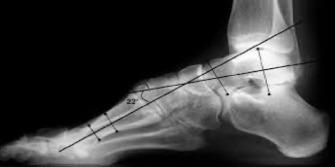
Assessing large “great” toe mobility is important to the design of classic boot orthotic forefoot posting as the impulse forces during kick are concentrated under this region. Anatomically, the larger bone, ligamentous and muscular components of the big toe make it an efficient levering device, able to transmit substantial force downward without injury.
However, it may be a contributor to undesirable medial edge loading during the glide phase if mobility is poor. Conversely it may “buckle” under load as ground reaction forces are transmitted upward if too mobile, compromising its ability to transfer “kick”.
Recall from the prior discussion on skate orthotics, that correction for individual alignment flaws can be accomplished either through midfoot control via arch height/tilt, or via cants placed on the rear and/or forefoot of the appliance. I find correcting for great toe mal-positions is most readily accomplished using cants (posts). Correction toward a neutral position is driven by exam measurements and expressed as degrees. Required degrees of cant are usually split between the rearfoot and forefoot posts. For example, if the correction to neutral requires 6 degrees of cant, 3 would be represented in the front post and 3 in the rear post.
If the athlete has issues with hypermobility of the first ray/great toe, a forefoot post which runs the full width of the device is used. It is canted the number of degrees the exam calls for, plus or minus, given symptoms, proximal structural or technique issues. The goal of the front post in this athlete is to “stiffen” the first ray and help with the timing and delivery of impulse to the snow during kick.
Forefoot 1-5 post below prior to grinding and feathering;
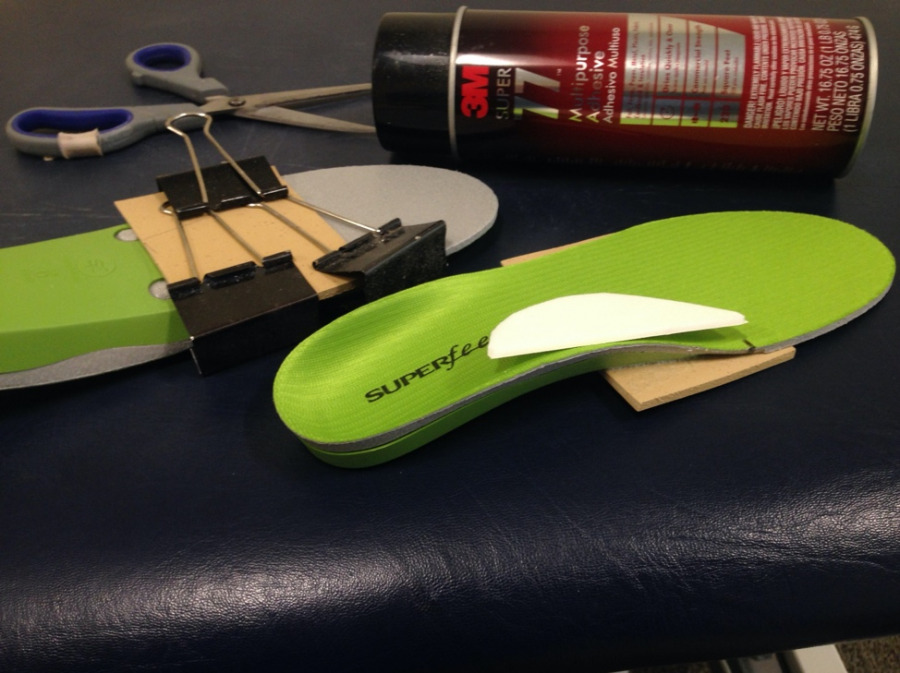
In the case of the “hypomobile” plantar flexed first ray athlete, the forefoot post provides opportunity to lessen focal great toe load and distribute some of that force to adjacent toes, specifically 2-3. Here a “cut out” or window for the first Metatarsophalangeal joint to drop into is utilized, thereby distributing the impulse and assisting with the maintenance of a flat ski.
Examples First ray cut out post below;
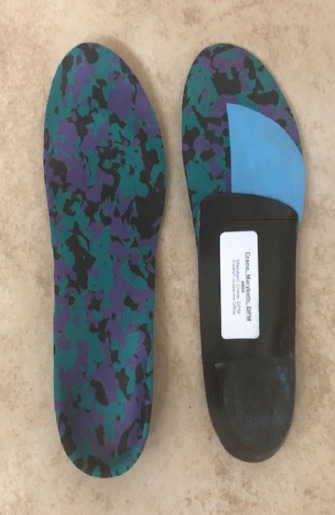
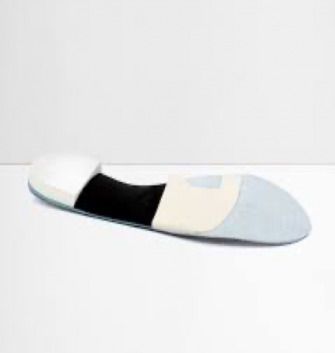
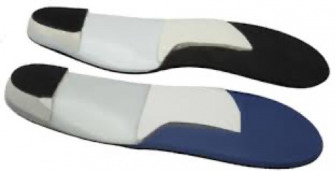
In the case of a neutral First Ray position and normal mobility, no forefoot posting is required and a simple ¾ length shell device with correction in the hindfoot as indicated.
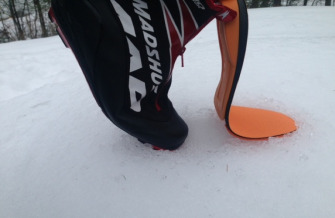
Material and placement of forefoot posts is much more crucial to classic orthotics than those fabricated for use in skate boots. The post must not impede the inherent forefoot flex of a classic boot, therefore must be a lower density material and placed just behind the Metatarsophalangeal joint row (ball of foot apex). The shell of the footbed may be fabricated from carbon but typically will be composed of softer thermoform or plastic. Often an off the shelf footbed will suffice as long as extrinsic corrective posts can be suitably adhered in place and feathered on a grinder.
Below; The flex point of a classic device should closely mimic that of the boot it is to be used in.
As with skate boot specific orthotics, an enhanced feel for the snow, efficiency of movement, power transfer and injury prevention are all worthy reasons to include classic specific orthotics into your equipment wish list.