
Herringbone Hell - Make a weakness a stRength
By Betsy and Bob Youngman
You cannot get good at something you do not practice. In cross country skiing one of the primary skills that is seldom practiced at full speed is the herringbone. Yet an efficient herringbone is a critical skill for classic races that have steep hill sections.
Herringbone skill deficiencies are observed across the spectrum of the skier population from recreational beginners all the way up to World Cup skiers. For a competitive masters skier who participates in classic races regularly, it is not uncommon to get caught behind a group of otherwise accomplished skiers on a steep herringbone hill, where the group is moving at a snails pace up these usually short sections. Adding to this severe pace reduction is the fact that, due to a high degree of technique inefficiency, many of these athletes are out of breath or "gassed" at the top of the hill and then have difficulty getting back up to race pace. It is clear that these skiers have not fully developed their herringbone skills, yet herringbone sections can play an important role in some races.
It is also important to point out that snow conditions can make an otherwise stride-able hill or DP hill section into a long herringbone. A recent example that we experienced was on the largest climb on the "B" loop at the 2019 World Masters Championship in Beitostolen, Norway. In the 30km/45km classic race, more than 12 inches of snow fell overnight and although the grooming team did an outstanding job at getting the tracks ready for the race, the course was still soft. Unfortunately, given the amount and type of snow that fell there was no way that (even utilizing multiple passes with the Pisten Bullies) the significantly soft skiing conditions could be avoided. Therefore, what occurred during the race was that the normally stride-able, 0.5km, 12% grade "B" Loop climb became a 0.5km herringbone, even for the best skiers. Between the soft conditions, the punchy pole track, and the numerous skiers on the loop, the deck turned to "mashed potatoes" while most of the track was obliterated by skiers herringboning over the track. The result was a "death march" of skiers slowly making their way up this section of the course. Early on a few skiers with proficient herringbone skill were able to slip by on the margins in a fast, efficient, narrow herringbone or a "Klaebo Klomp." But the overwhelming majority of skiers in the race were unprepared for this (or any) herringbone. For those skiers with sufficient herringbone skills, this situation presented the opportunity to catch, pass, or put significant time on other competitors. For those without such herringbone skills, what was a three-minute stride-able climb became a four to five-minute slog and exhaustion at the top.
With an efficient herringbone this climb might take about 30 seconds longer when compared to striding and so for those without sufficient skill, several minutes were “lost” – minutes which typically represent the difference between a podium and a top-10 finish for a masters competitor. For younger skiers in more competitive fields, the lost time could mean the difference between a top-10 and a mid-pack finish. This is why we argue that it is important to be skilled in herringbone and to be prepared to efficiently attack herringbone sections in cross country ski races.
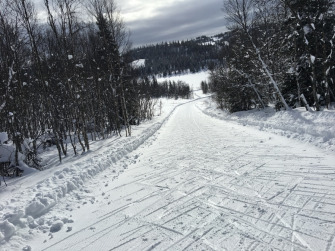
A portion of the climb on the "B" Loop at the 2019 Masters World Championships in Beitostolen, Norway. With over 12" of snow the night before, this stride-able climb became "Herringbone Hell" during the 30km/45km classic race where many racers were challenged due to deficient herringbone skills. Seen here the next day after the snow had set-up and was groomed for the 30km/45km freestyle races. An efficient herringbone on this climb was worth minutes in the classic race.
We will not provide guidance on specific technique pedagogy as this will be best delivered via an experienced, up-to-date cross country ski instructor or coach. There is much technique material here at Nordic Team Solutions as well as on the web. However, we will describe an intensity session that, in addition to being a great cardiovascular workout, serves as a very functional tool for development of efficient herringbone technique.
The Workout -- "Herringbone Hell"
A primary part of the skill base needed for an efficient herringbone is neuromuscular in origin. As in any coordinated movement of multiple limbs, the body responds in unique ways to repeated bouts of movement requiring such coordinated movements. This is because the mind will use the naturally occurring pattern recognition abilities present in all humans. As one repeats a complicated, multi-limb movement such as a herringbone, the mind "wires" this movement pattern into an efficient muscular firing sequence that eventually becomes "wired-in" when practiced enough. The biophysical process is called myelination and is an important part of any coordinated movement. But myelination will not occur without repeated bouts of specific movements. The first step to an efficient herringbone is practice, i.e. bouts of herringbone repeats up steep hills.
"To sum up: it’s time to rewrite the maxim that practice makes perfect. The truth is, practice makes myelin, and myelin makes perfect".
Daniel Coyle, author of The Talent Code
Daniel Coyle, author of The Talent Code
We have found the following workout to be very effective in rapid development of herringbone skills. The workout combines neuromuscular and technique development with an intensity session aimed at eliciting speed development and increased turnover.
Start with a 20-30 minute warm-up of easy skiing while locating one or more suitable "herringbone” hills. These are hills that would be difficult to impossible to stride efficiently. Such hills are usually 15-20% grade, although, as noted above, snow conditions can play a role. We prefer using three different hills to break up the monotony and to expose us to different hill "characters." Once warmed up, begin the following sequence:
- total of 15 X 45s herringbone hill repeats at L4 (Supra-Threshold)
- 3 sets of 5 repeats with full recovery between efforts and five minutes rest between sets
- easy cool down ski for at least 30 minutes
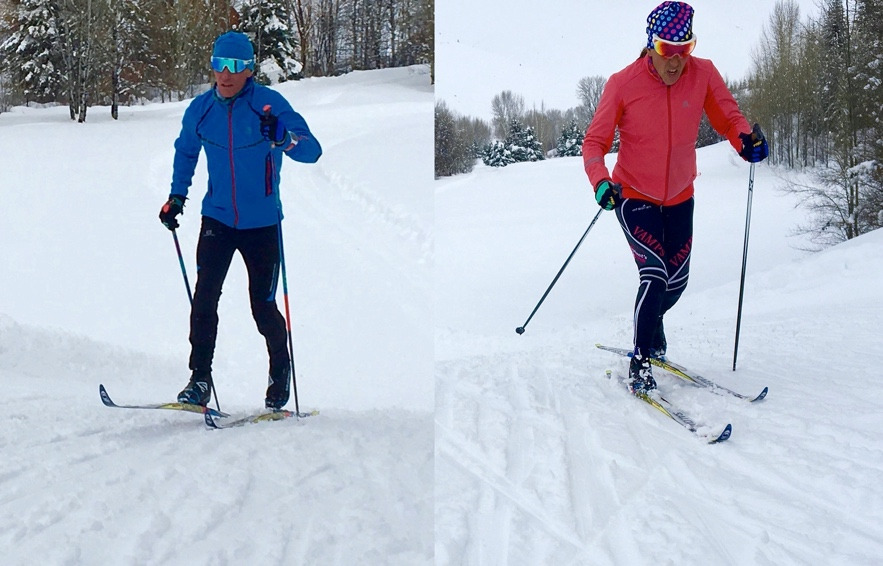
Rep number 8 of 15 in the "Herringbone Hell" workout... the technique is coming along and the effort is high!
It's a tough, but enjoyable, session because you will quickly see improvement in your herringbone – just with a single session. We call it "Herringbone Hell,", but with skill development it will become "Herringbone Heaven!" Add this workout to your selection of regular intensity sessions, and you will soon find herringbone to be an asset and not a liability. And, at your next race, you may find yourself out on the margins of the track in herringbone sections actively passing your competitors with an efficient, fast herringbone!