Road Safety for Summer Training
By: Amanda Kautzer
NTS Enjoy Winter Factory Team member
As Nordic skiers, training isn’t so much something we do as it is a part of everyday life. Most of us have been training 5-8 times a week for years, and for some, decades. While this is great for building fitness, it can also lead to complacency when it comes to safety; when you do something almost every day, it’s easy to forget that it can be dangerous.
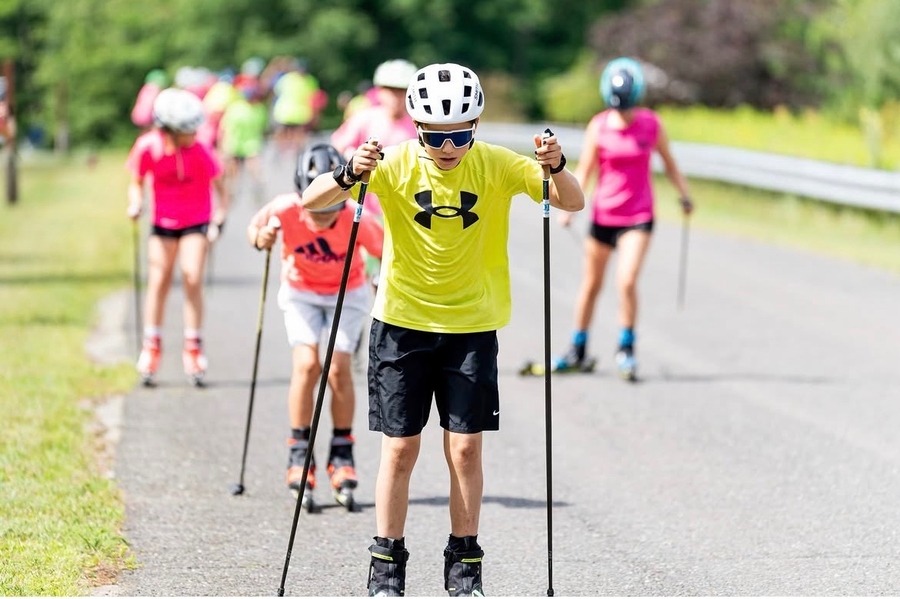
The number one safety consideration for summer training on roads, whether rollerskiing or cross training, is being visible. Wearing bright colors ensures drivers can see you, and therefore is extremely effective in minimizing vehicle/rollerskier impacts. In the heat of summer, it can be tempting to ditch the shirt, which also usually means losing your hi-viz. To mitigate this, I try to pick shorts, a water pack, helmet, and gloves that are bright colors. While a shirt gives you the most surface area, and therefore most visibility, the movement from bright gloves and a helmet as you ski is better than nothing on the hottest days. When biking for cross training, bright colored socks or shoes are also extremely effective.
When on the roads, it’s also important to think about the color of your surroundings. When everything is a lush summer green, hot pink or orange stand out the most. However, when the colors start changing (if you live somewhere lucky enough to have fall colors!) oftentimes a neon green or blue offers the most contrast.
For many readers, always getting to train during daylight isn’t a luxury their job/kids/life allow. As days start getting shorter, it can also be helpful to add reflectors or lights. I personally like to put a red light on the back of my helmet, as that’s an item that I use for biking as well as skate and classic rollerskiing. I’ve also had a lot of success with reflective tape on the back of ski boots and water packs.
Another consideration for road safety is where you physically are on the road (assuming there’s not a bike lane or significant shoulder protected by rumble strips). In college, my international teammates always claimed the safest way to rollerski was to take up the whole lane. Logically, this makes sense: if you own the whole lane, a driver is forced to wait behind you until they can make a proper pass fully utilizing the opposing lane. By having to wait for an opportunity, it drastically reduces the possibility of being “buzzed” by a driver trying to sneak by with vehicles in the oncoming lane. The “Euro” method also assumes the driver is paying attention, and isn’t prone to road rage, two things we unfortunately can’t always assume here in the States. Personally, I like to ski/ride where the right tire of a car would be. This improves visibility; drivers are more likely to notice something in the lane rather than on the shoulder or on the white line. It also encourages drivers to wait for an opportunity to pass in the oncoming lane. And, finally, it gives me enough space to bail if I see, or hear, that a driver isn’t planning on passing using the aforementioned technique.
These concepts become even more important when skiing in a group. As a general rule, it’s best to keep group sizes small when on public or well travelled roads. While it can be fun to ski with all your friends, there’s nothing good that comes from getting hit by a car, or angering the local residents. Other considerations when evaluating group size are location and time. If you’re in close proximity to an Olympic/Paralympic center that regularly sees athletes training on the road, a larger group might be acceptable. On the flip side, if you’re at a random training camp where the locals have never seen rollerskiers, it’s probably best to keep group sizes small and avoid peak traffic time, like Saturday mornings or rush hour.
Last, but absolutely not least, wear a good helmet. Helmets should be replaced every three to five years, and immediately after a crash. If you can’t remember when you bought it, it’s probably time to replace it. If the color has faded from hundreds of hours in the sun, it’s probably time to replace it. If you opened your tail gate and it tumbled out onto the pavement, it’s probably time to replace it. When looking for a new helmet, two great resources are The Bicycle Helmet Safety Institute (https://helmets.org/) and Virginia Tech’s Helmet Rating site (https://www.helmet.beam.vt.edu/index.html). Both of these sites have detailed analysis of specific helmet models and other important considerations too numerous to repeat here.
Ultimately, summer training safety comes down to building good habits and remembering that familiarity doesn’t eliminate risk. The roads we train on are shared spaces, and a few simple choices—wearing high-visibility gear, choosing smart training locations and times, and protecting yourself with a quality helmet—can make a huge difference. We spend countless hours preparing our bodies for the demands of skiing; putting in a tiny bit of extra effort to consider safety when we train ensures we are ready for winter and can keep doing what we love for years to come.