
The PoweR of PlantaR Flexion
By Kurt Jepson,
As with any sport, Nordic skiing technique refinements boost performance and ultimately enjoyment, whether on the race course or your favorite woodlands trail.
When we hear phrases such as, “finish the kick” or “complete the lateral push and release the ski”, what are the objectives of those technique cues? Let`s take a look at the act of “plantar flexion” of the ankle and it`s contribution to propulsion, stability and efficiency.
To start let me acknowledge that most of the research alluded to in this article relates to subjects walking and running. It is always a scientific “slippery slope” when drawing biomechanical conclusions from analysis of different bipedal activities. That said, the parallels between the “gait cycle” and a “skiing cycle” from contact to push off are not insignificant in terms of sequence, position and muscle function utilized to perform the kinematic task at hand.
Plantar flexion is a predominantly sagittal plane movement of the foot/ankle complex toward the ground. When we complete a standing calf raise, walk on tip toes, push the gas pedal, etc. we are plantar flexing the ankle. Arthrokinematically it involves triplanar motions of the talocural (ankle) and subtalar (hindfoot) articulations.
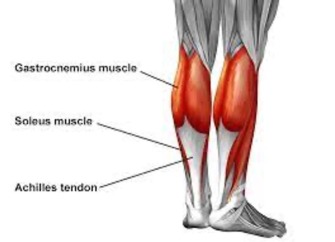
Plantar flexion is produced by the powerful Gastroc-soleus (GS) muscle group comprising the posterior compartment of the calf. Secondary contributing muscles include the toe flexors and Posterior Tibialis (anteromedial shin). The Gastrocnemius is considered a two joint muscle, acting on the ankle as well as the knee serving there as a flexor. The Soleus is a flat, broad muscle deep to the Gastrocnemius acting only on the ankle joint. The GS complex is also referred to as the Triceps Surae.
The GS complex utilizes the Achilles Tendon for durable insertion onto the calcaneus (heel bone). The Achilles is worthy of discussion independently as it has the ability to store “elastic” energy. This “potential” energy accumulates during the deceleration phase of gait, following heel strike and continues through early and mid-stance (Neptune et al, J of Experimental Bio, 208, 2005). This “energy” when released, is a dominant contributor to ankle plantar flexor force, and hence propulsion. This occurs during steady state running as well as sprinting (Lai A. et al. Human ankle plantar flexor muscle -tendon mechanics and energetics during maximal acceleration sprinting. J. R. Society, 13, 2016). It appears that Gastrocnemius and Soleus muscle contraction is hampered by elevated velocities involved with running (Farris DJ, Sawicki GS, Dept Biomed Engineering UNC/NCS, 2011). The Achilles Tendon therefore, serves as a “capacitor” for plantar flexion force required for propulsion during high-speed activity.
It should be noted that the muscle contraction velocity studies available for review utilize walking and running gait as the focus of experimental measurement. It is reasonable for the purpose of discussion, to acknowledge that speeds of contraction of the GS muscle complex also vary throughout the cross-country skiing cycle based on speed of the skier, terrain and/or technique employed. The Achilles likely serves as a force capacitor in skiing as well.
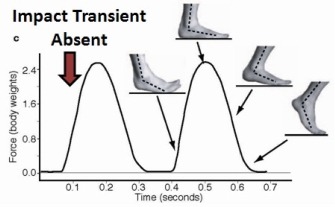
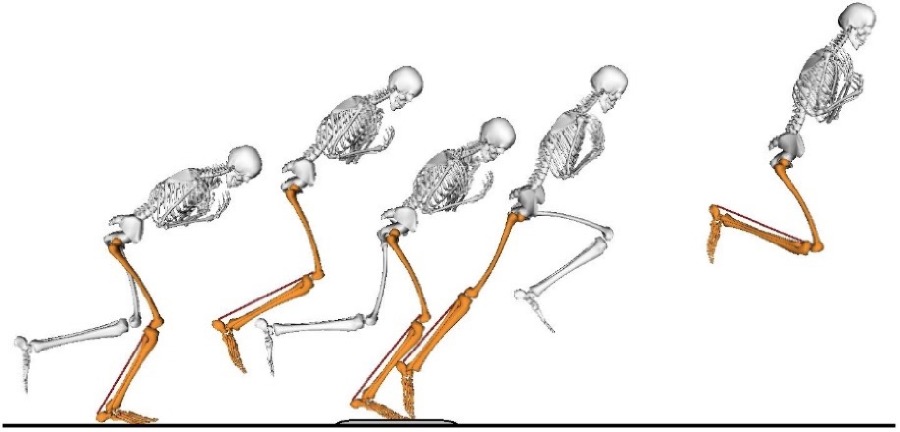
As with running, there is an eccentric loading component of the GS and Achilles complex in skiing as we move onto the new glide ski. This is followed by a brief isometric phase at mid glide and finally a concentric pushing phase at terminal glide/early propulsion. While the joint angular speeds of the ankle differ running verses skiing, the concepts of eccentric loading (foot strike), energy storage in the tendon (stance) and muscle contraction/shortening (propulsion), would seem kinematically similar. Of particular note is that “stance” (glide) comprises the majority of the ground contact time frame in both activities.
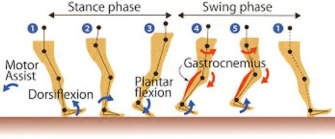
Gait cycle; running and skiing
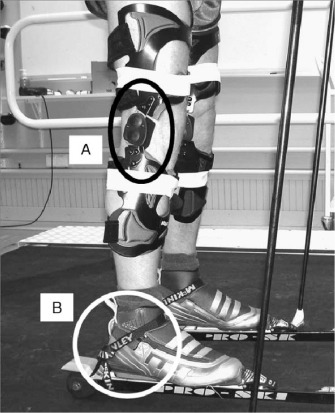
A review of the literature produced no specific studies pertaining to Gastroc-soleus and Achilles Tendon activity during the skiing cycle. There have however, been studies examining the contribution of lower extremity muscle groups to skier propulsion, even when double pole (DP) only technique is utilized. A work by Holmberg HC et al published in 2006, Contribution of the Legs to Double-Poling Performance in Elite Cross-Country Skiers (Med Sci Sports Exer), examined variables such as VO2 Max, heart rate (HR), Lactate levels, poling velocity and pole ground reaction forces while the subjects were either “locked” via bracing of the knees and ankles or free to move their lower extremity joints while on a 1% incline treadmill.
Data analysis identified a 7.7% higher peak VO2 Max, 9.4% higher velocity max, 11.7% longer time to exhaustion, lower average HR, and lower blood lactate levels when the knee and ankle joints were free to move. They concluded that knee and ankle joint contribution to DP is indeed significant and dynamic use thereof, improves skiing performance.
Holmberg study “locked” position for DP
The obvious take away is that knee and ankle musculature not only affect skier propulsion directly during push off, but indirectly as well, via improved torso and upper quadrant function, lactate management and systemic perfusion.
What contribution to propulsion do the Plantar Flexors actually yield? If we return to the walking and running biomechanical research, we find a 1998 study by Marjan et al in the Scan J Rehab Med where the investigators quantified Plantar Flexor force during walking at 23.1 Joules (J) of energy during push off, with only 4.2 J of this number transferred to the trunk for elevation and the remainder used to initiate the forward swing of the limb toward the next stride. They concluded that the ankle Plantar Flexors are important, in fact dominant contributors to forward kinetic motion at “push off” and that body mass elevation against gravity likely occurs via input from other muscle groups (hip and knee extensors).
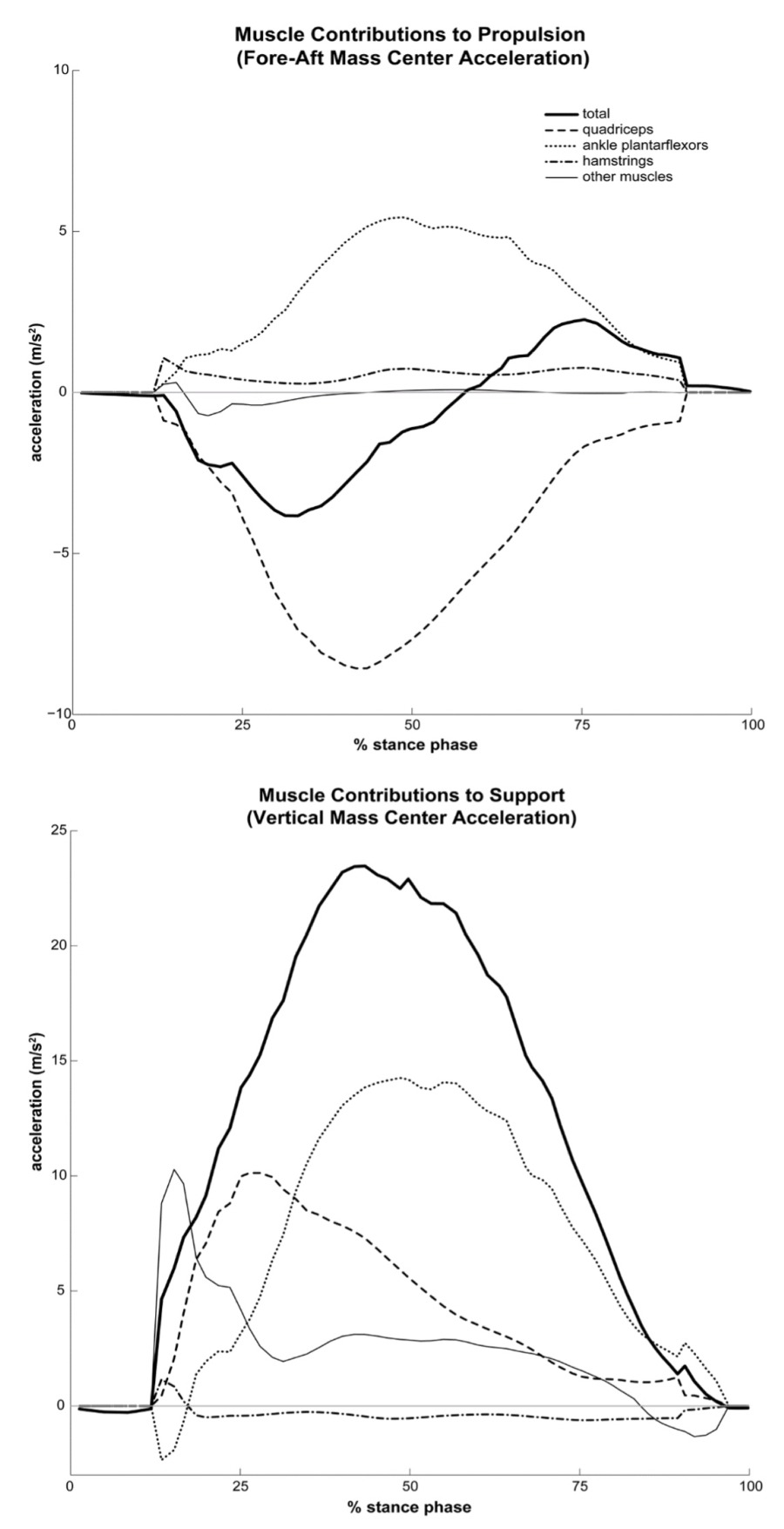
An excellent 2010 work by Hamner, Seth and Delp published in the Journal of Biomechanics, calculated the plantar flexor contribution to forward movement and acceleration of the body center of mass at over 50% of total lower extremity muscle activity of a subject running at a 6:46 /mi pace. Although the study involved only one subject, the data collection and analysis were exhaustive, utilizing 92 musculotendinous actuators representing 76 lower extremity and torso muscles, a force plate treadmill, extensive EMG data and specific mathematical calculations of vectors, velocities, loads and movement patterns. They found the Gastroc-soleus complex most active in this role at mid to late stance, prior to toe off. It provided twice the peak forward acceleration and over half of the vertical body mass support compared to other muscles involved (Muscle contributions to propulsion and support during running. J Biomech. 2010. Oct 19;43(14)).
The concept of forward mass acceleration, as it relates to skiing, becomes obvious as we release the “pushing” ski and direct it forward to the next glide phase during classic or skate technique.
Consistent with other investigators, Marjan noted significant energy storge occurring (eccentric loading/ braking/deceleration, etc.) in the GS muscle and Achilles complex during the stance phase of the non-swing leg. They speculated it would be used later for the swing component of that limb.
From a functional movement standpoint, Plantar Flexor eccentric (controlled lengthening) activity during stance, or in skiing`s case glide, slows the rate of dorsiflexion as we load the extremity and ski. Rapid dorsiflexion would destabilize the mid foot, enhance pronation, adversely affect our stable platform and encourage unwanted inside edge “plowing”. Eccentric Plantar Flexor activity also allows the Achilles Tendon the opportunity to storge elastic energy for use later.
Eccentric loading of the stance leg prior to impulse. Note the ankle angle and resultant calf stretch.
The elastic energy stored in the tendonous components of the Plantar Flexor groups is substantial and becomes a higher percentage of overall force production as the speed of movement increases. This is due to the intrinsic muscle fiber characteristics of the Gastrocnemius and Soleus.
Every muscle has an ideal contractile velocity at which it can generate force and, in the GS case, the faster the joint speeds, the less able these two muscles are able to generate elevated forces. The Achilles is left with the task of making up for this deficit as speed requirements increase. Interestingly, if speeds build and are sustained, the short, wide (pennate) fiber design of the Soleus muscle in particular are unable to produce more contractile force and the storage and release of kinetic to potential energy within the Achilles tendon becomes a vital source of added propulsion (Lai et al , Human ankle plantar flexor muscle tendon mechanics and energetics during maximum acceleration and sprinting. J.R.Soc. Interface. 13, 2016).
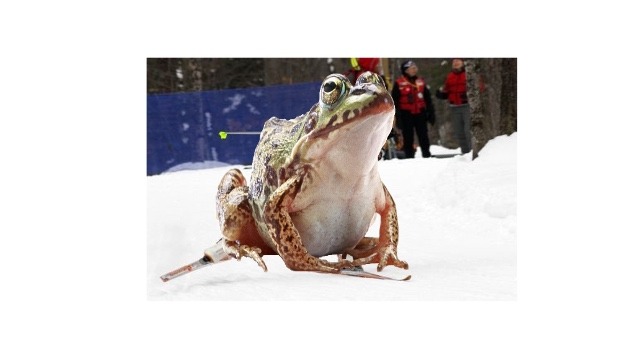
The additional power gained via tendon elasticity/recoil is approximately 30 to 50% greater than the muscles fibers are able to generate alone (Lai, Roberts, Scales). One animal study calculated that the tendon contribution for a jumping frog was 7 times that of the hind leg musculature itself!
Oh, to be a frog!
It is obvious that powerful plantar flexion is vital to maximizing bipedal propulsion. The trick is accessing this resource as a skier. The cues of; “push through the forefoot”, “finish the kick” and “release the ski” offer insight into what the end of the skiing cycle should consist of. The skier must “feel” the load building and being released from the forefoot. This takes repetition and sensory awareness, as does every aspect of skiing. Simple weight shift dryland skiing specific movement drills done in unshod feet can enhance this.
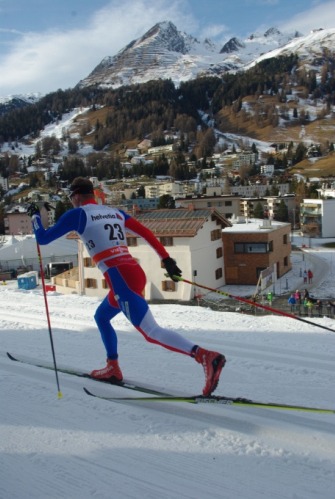
Visually, Plantar Flexor contribution while skiing is represented by observing the distance between the heel of the boot and the rear binding plate at terminal push. The greater the foot-ski separation, the greater the extent of GS (plantar flexor) activity. Every athletic movement involves follow through to reinforce purpose and efficiency.
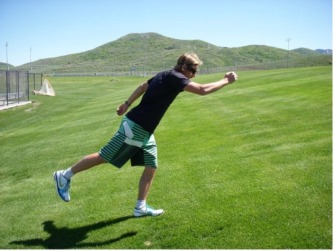
Take a look at the skating videos above and note the degree of release at the ankle and the heel to ski “gap” /distance as the lateral push concludes (or lack thereof!).
Skiers that finish the push cycle with a “flat foot” are likely leaving valuable propulsive power on the table. Skiers completing the cycle with dynamic lower leg activity and “follow through”, are maximizing Plantar Flexor force to the snow.
As speeds of contraction increase, Achilles tendon “recoil” becomes a major source of power for forward progression at terminal push off, theoretically 50% of the lower leg contribution at high joint speeds (Lai, et al, Neptune et al).
As Nordic skiers we can best utilize this potential source of energy by enhancing our specific lower leg fitness. Weist R et al demonstrated a 9-12% reduction in Gastrocnemius and Soleus strength via EMG readings in a post run fatigue state (A J Sports Med. Dec. 2004).
Proximal hip strength also plays a role in GS function. Radzak et al ( J Ath Train. 55(12), 2020) found that by inducing fatigue in the hip abductor group, there were resultant increases in hip and knee adduction and internal rotation moments which kinematically induce mid foot pronation, hindfoot eversion and GS stretch weakening and compromise of vertical support. There are confirming studies too numerous to list.
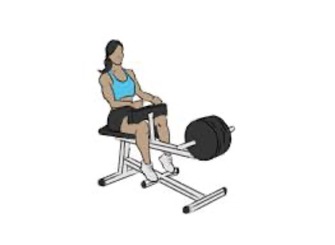
The Soleus has the best chance of retaining contractile integrity in flexed knee positions while skiing as it is a single joint muscle. Seated calf raises in the gym may be a useful addition to other resistive calf work.
Another strategy to maximize Plantar Flexor activity is to utilize the Stretch Shortening Cycle (SSC). The SSC is not a new concept to Nordic skiers. Any plyometric exercise routine employs this physiologic principle. In theory we should be able to better able to plantar flex “with intent” utilizing the SSC. The question is, does the SSC apply to the GS complex as it does to larger muscle groups (ie knee extensors, Nikolaidou et al 2017, Aeles et al 2018)?
A 2019 work published in Frontiers in Physiology looked at this very question (Aeles J and Vanwanseele B, Do Stretch-Shortening Cycles Really Occur in the Medial Gastrocnemius? A Detailed Bilateral Analysis of the Muscle- Tendon Interaction During Jumping).
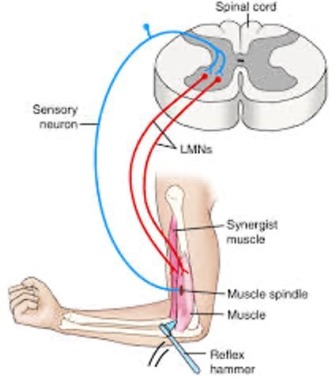
In short, the SSC is a concept based on the function of stretch responsive sensory fibers called “Muscle Spindles”. Spindles lie in parallel within the muscle fibers themselves (intrafusal) and reside at the joint level and/or the muscle tendon level.
Their function is to prevent fiber injury via excessive elongation/tensioning of a given muscle. When stimulated by a “quick stretch or load” these tension sensitive “afferent” organs enact a monosynaptic contractile response which utilizes a singular spinal cord communication “loop” to achieve the desired “efferent” (Alpha motor neuron) response. This shortened pathway saves time and results in an immediate and substantial muscle contraction which is load and speed specific. The higher the extrinsic force, the greater the muscle contractile response. When a clinician tests the “knee jerk” Deep Tendon Reflex as part of a neurologic exam, the “jerk” response is fueled by the SSC mechanism.
Aeles and Vanwanseele studied highly trained jumping athletes (n=9) as they performed a single-leg hop task at maximal effort. Gastroc-soleus Muscle Tendon Unit (MTU) data was collected for trials which included a force plate monitored “pre-hop” loading movement to stimulate the SSC. They expected to see a significant SSC response at the level of the joints, MTU, isolated muscle fibers and tendon fibers. What they found was that the Gastrocnemius muscle itself, despite being activated by the SSC input, was highly force compliant. It lengthened very little when stretched abruptly and even contracted isometrically perhaps in an effort to “protect” itself by dissipating force. The majority of recoil velocity at takeoff, was isolated to the “series elastic element” aka, the Achilles tendon, in response to its length change, the SSC input and subsequent release of stored energy.
When we do plyometrics are we really training muscle response time and rapid force production or are we simply building tendon durability and elasticity? In terms of the GS MTU it appears to be the latter. Functionally it likely does not matter, as the SSC has beneficial inputs to propulsion regardless of tissue activation level.
World class skiers maximize Plantar Flexor power, perhaps subconsciously, by utilizing a pre-activation impulse or “hop” as they load the ski for push off. They are using the SSC and the structural characteristics of the GS MTU to stimulate energy storage and release. This occurs via a dedicated “hop” movement prior to push off while skating when the situation demands more propulsion, or via knee and hip flexion just prior to the kick impulse while classic skiing. The faster the speed of the skier, or more difficult the terrain, the more pronounced the behavior.
Right side knee and hip flexion, resultant calf stretch and SSC activation prior to CL kicking below.
In conclusion, don`t leave valuable propulsive energy under-utilized in the lower leg. Load, FEEL , push, release, follow-through and enjoy the sense of “snappy” skiing like the pros!