
Fat ConsumPtion foR Athletes
By Andrea Henkel Burke
All fats, except trans fat, which don’t exist in nature, are there for a reason. For a long time, fat had a very bad reputation. However, it turns out that this is only because of a scientific report, which was actively guided and supported by the sugar industry. This report related fat consumption with cardiovascular health issues. These days, fats are getting back on our plates with additional research that proves fats are not so bad after all!
Fat and fatty acids are elementary components and have important functions in our bodies. Some of these functions are:
- Forming important parts of cell membranes
- Energy provider
- Temperature regulation/ isolation
- Absorption fat solvent vitamins
- Absorption of nutrients in intestine
- Absorption of calcium into bones
- Feeling longer satisfied after meals
- Inflammation and anti-inflammation
- ...
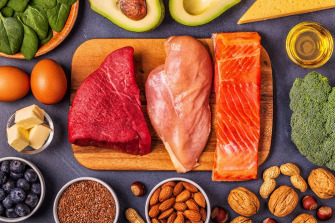
Often it is not that a certain kind of fat is good or bad for us, it’s actually the ratio between saturated fats and unsaturated fats, as well as the ratio between polyunsaturated fatty acids that are the most important to get right. In this article I want to take a closer look over those polyunsaturated fatty acids, also known as Omega 6 and Omega 3.
Both Omega 6 and Omega 3 fatty acids are essential for us. This means our bodies can not produce them on our own and we need to get these through food - in the right ratio. Current research shows that the general population is way to high in Omega 6. And many people have a ratio of 15:1 Omega 6: Omega 3 all the way to 25:1 or even higher. I would say it depends on the test group. Regardless, everyone agrees that 15 or 25 are very high numbers for Omega 6 compared to Omega 3. We should aim for something along the lines of 4:1 or even less.
Omega 6 is important for many reasons, such as blood clotting after injury. Omega 6 also creates inflammation around a wound to “tell” the immune system where it needs to pay attention.
Omega 3 on the other hand is anti-inflammatory. When our wound heals up again, also the inflammation is not necessary anymore and Omega 3 helps with that. Our cell membranes are made with Omega 3 fatty acids, if our body gets enough of it. Omega 3 is very flexible. When we don´t have enough Omega 3, our cells need to take what they get. A blood cell membrane for example, made mostly from Omega 3, is fitting much better through our arteries than a stiffer cell with a membrane made out of other, less flexible fats. The stiffest cell membrane is using trans fat, which is modified fat made through food processing. When you read on labels “no trans fat“ it means they were not putting trans fat into the product. Still, there is a chance sunflower oil, or other vegetable oil became a trans fat through the process. By heating up unsaturated fatty acids to a certain temperature, the fatty acid changes it’s structure and becomes a different fat, a trans fat.
EPA and DHA are well known as Omega 3 fats, they are important for eye and brain health. EPA and DHA is in fatty fish or fish oil. Flaxseed oil or chia seeds carry the vegan version of Omega 3, alpha linoleic acid. Linoleic acid can be converted by our body to EPA and DHA, the form of Omega 3 our cells are using. Unfortunately, the conversion is not very efficient and most agree that only about 10% is converted. This means a maximum 10% of alpha linoleic acid will be converted to EPA and DHA.
When Omega 6, our pro- inflammation fatty acid is too high compared to our anti- inflammation fatty acid Omega 3, we are more likely to find inflammation in our body, injured or not. This is not good for recovery and high performance. Inflammation creates free radicals, which in turn create more inflammation. Free radicals damage our cells and our energy producers, the mitochondria. Inflammation and free radicals are extra stress for our cells and immune system. When we are sick or injured, we reduce training and activity to give our body time to recover. Now imagine having ongoing inflammation in your system - it’s not possible to use all of your potential.
To get a good ratio of Omega 6 and Omega 3, we need to know what to eat, and also what not to eat. We already talkedabout Omega 3, now let´s take a closer look at Omega 6 sources. You definitely get enough Omega 6. You need to be more aware of not getting too much of it. Omega 6 is found a lot in sunflower oil and other vegetable oils. You also find it in corn, soy, peanut butter and nuts. It also is higher in farm raised animals, which often get fed with soy and corn.
I am doing two things to avoid extra inflammation. I try to keep my Omega 6 intake low by rarely using vegetable oil and never using sunflower oil at home. Please check out labels and you will see lots of sunflower and vegetable oil. I am also very lucky to have wild animal meat in my freezer. When I buy meat, I prefer organic grass fed.
On the other end, I keep my Omega 3 level up by eating fatty wild caught fish. Of course I don’t eat fish every day for multiple reasons, but also because we know that our oceans are not toxic free. That’s why Omega 3 is part of my daily supplement protocol.
When supplementing, please make sure you use a high quality supplement, which is not madeout of toxic fish waste.
Here is what´s in my pantry.

If you like to read more about this specific product, you can use this link.
Once talking about fat, here is also a quick not on Omega 9. Omega 9 is a mono unsaturated, anti-inflammatory, very healthy fatty acid, found in Avocado or cold pressed good quality olive oil. When cooking with olive oil please don’t heat it up over 360 longer than 10 minutes! At this temperature Omega 9 starts to break down and become trans fat.
I hope after reading this you are more comfortable with consuming fats. They really are a great thing when consumed properly, and in the right ratios!