
EncouRaging Thoughts for MasteR SkieRs
By Betsy and Bob Youngman,
In this time of pandemic many athletes are confronted with significant uncertainty across all aspects of their lives. For the athlete, this can lead to challenges with motivation, particularly when the upcoming competitive season is potentially not going to happen. Combine this with the reality that training for cross country skiing is a year-round endeavor where a majority of training happens off snow, and some of the fundamental, longer-term, aspects of our motivational drive begin to be eroded. Putting in the long hours of aerobic base building, maintaining focus for critical high intensity work, and attending to identified weaknesses are all more difficult to do when there are diminished long-term goals, or worse yet, goals that no longer exist. As we have discussed in a prior article on time horizons, setting goals, and training plan structure, having short and long-term goals and a plan on how one is going to achieve these goals is fundamental to athletic success, be it achieving a personal goal or a competitive goal. These goals are also fundamental to the derived motivation that one develops with commitment. When previously made long-term goals become uncertain, our motivation will naturally wane. Many elite summer athletes are currently dealing with this now that the Tokyo Olympics have been postponed a year. We are dealing with this as well because the 2021 World Masters Cross Country Ski Championships in Canmore, AB Canada are uncertain at this point. These annual “World Cup”- style races represent the most competitive international age-group opportunities and the series provides four races (including a relay) in ten days making for a great experience for a competitive ski racer. Without the World Masters Championships, a big part of our motivation is impacted. Add to this the fact that, at this juncture, all domestic races are uncertain and one may find their motivation to train substantially affected.
We also need to appreciate the direct and subliminal stress of dealing with the COVID-19 restrictions on physical and social interactions and the reality that, depending on the person, heightened “real-life” stress can have significant negative impact on energy levels, recovery, and sleep.
But, as is often the case, such challenges can also be viewed in a different, more favorable, light. Yes, cross country ski competitions are potentially off-the-table for the 2020-2021 season, but there are other goals and objectives that can substitute for racing, particularly for the masters skier. Suggestions for modified and/or alternative goals and objectives are reviewed here.
Revert to Specificity
We could go on at length about how to stay motivated under the current (pandemic) circumstances and that is an important thing to attend to. However, here we speak to the operational side of the issue, i.e. what can a masters athlete do with diminished motivation and still make progress. This is an approach that looks to identify those aspects of training where we will derive the maximum on-snow benefit and thereby make the most of what motivation we still have. Our shared experience during this sort of situation is to revert to specificity. By this we mean to adjust one’s training program to emphasize sport-specific activities and to move away from activities that are less directly translatable to on-snow performance (while still maintaining “fun factor” cross training activities like white water kayaking!). This approach is one that is successfully used when one has less time to train, while coming back from sickness, or in the later stages of injury recovery. It can also be used when motivation is lower. Such sport-specific activities have a “bigger bang for the buck” for the time invested and, with lowered motivation, less time training is likely a given. We’ll take what motivation we have and optimize it for the largest gains possible! Certainly, this is no replacement for a full, multi-faceted, integrated training program, but at least we can make some clear improvements in important areas that might otherwise not see as much focus in our regular programs.
Additionally, for the masters skier, we tend to not put as much emphasis on sport-specific training activities as we likely should. Doing so requires identifying weaknesses and putting together a plan of sport-specific exercises that address these weaknesses. More typically we “live with the inadequacies” because we would rather ski or mountain bike or go running and “maintain our aerobic base” or for some such other reason. Here we take a negative influence (diminished motivation) and turn it on it’s head to produce long-term improvements that we can take advantage of once our motivation (and the current world situation) returns to whatever “normal” will be in the future.
Revert to Specificity -- What is it exactly?
Specificity is engaging in exercises that are specific to your sport. For cross country skiing this includes properly designed max strength/general strength exercises, plyometrics, double pole roller skiing, and bounding with poles, among others. Since we are planning to utilize these exercises to make personal sport-specific improvements the specificity needs to be specific to you. This involves assessment of your weaknesses and is best done with an experienced coach and, often, video analysis of dynamic movements. Don’t be shy - contact your local cross country ski coach and ask if they might be able to help you with this assessment (along with some remuneration) and design a set of sport-specific exercises to help you address any weaknesses that have been identified. Alternatively, a qualified Physical Therapist (PT) familiar with cross country skiing movements can make assessments and provide direction on appropriate exercises and progressions.
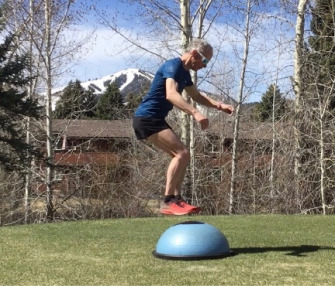
For us, assessments have identified a couple of primary weaknesses; for example we are working on: engaging and developing Type-II muscle, improvements in double pole motion, single-leg balance, and classic kick timing. We’ve adjusted training programs to emphasize exercises that address these weaknesses. To accomplish this we will include a higher proportion of plyometrics, video feedback during double pole roller ski sessions, single-leg Bosu ball balance drills, and single-leg plyometric uphill hops. By focussing on these identified weaknesses, whilst not as “fun” as other training modes, we expect to see significant on-snow performance improvements. These sport and person-specific training foci are not time-intensive but they do require commitment and consistency. However, it is much easier to find 30 minutes and sufficient motivation to do these exercises than to find 2 hours and significant motivation for an aerobic run, roller ski, or mountain bike. The “bang for the buck” in invested time and motivation is much greater for the sport-specific exercises.
Some General Examples of Sport-Specific Exercise for Masters Skiers
There are some general approaches to making one’s training more sport-specific. For cross country skiing these include:
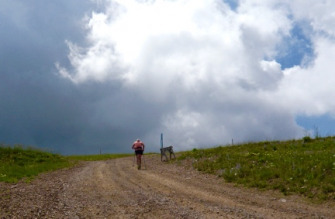
Hill Bounding With Poles: There is an old adage in dryland cross country ski training - “whatever you do, do it with poles.” The idea is that the use of poles is central to all skiing motions and the extent to which one engages with poles in their training will have a large effect on skiing performance. To this end we highly recommend that athletes use their poles whenever they hike, run, or do uphill intervals. The added upper body and core engagement with the striding movement is adding not just strength development but also upper body muscular endurance (from long hikes or trail runs) and substantial neuromuscular adaptations that will translate directly to on-snow performance. We do all hikes with poles and, increasingly through the summer, include poles with run workouts. In all cases utilizing proper bounding technique, and when the trail gets too narrow, either lifting the poles horizontal or taking them off and carrying them. With the introduction of significant intensity in August, we do all intensity sessions as uphill hill bounding with poles. By October all aerobic and interval training is completed with poles for the remainder of the dryland season. The consistent engagement with poles in dryland is, of course, naturally included if roller skiing plays a large role in your training.
Plyometrics: We have spoken about the importance of plyometrics in previous articles, but here we stress that, for the masters skier, plyometrics represent one of the “biggest bangs for the buck” of training time relative to performance impact. There are few opportunities to truly and effectively engage one’s type 2 muscle mass and plyometrics are far and away the best approach. A consistent diet of two to three 30-minute cross country ski-specific plyometric sessions per week throughout the dryland season will yield substantive on-snow performance impact. Although older skiers will often have some level of compromised connective tissue (which will alter how one does plyometrics), working with a strength training professional should allow for a safe and effective program of plyometrics for almost any skier.
Double Pole Roller Skiing: Although we include significant roller skiing in our training programs, we realize the risk associated with this activity. There is no question that roller skiing is one of the most dangerous training modes for cross country skiers and this is magnified for masters skiers where long-term injury risk is heightened due to connective tissue issues and overall lower impact compliance should one crash. However, there is one mode of roller skiing that is much less risky than all others: double pole roller skiing on a generally controlled gentle (1.5-2% grade) slope. It is relatively easy to control roller skis on such gentle slopes and this level of grade is challenging enough to allow for a very good aerobic or interval workout. Doing this roller skiing on a 2-3 km loop or an out and back on a section of road or path that is fairly controlled (i.e. low traffic and smooth surface) will minimize the not insignificant risk associated with roller skiing. One can also add a weight vest or speed reducers and turn a 2% slope into the equivalent of a 3%-5% slope for additional challenge and for progressions (just make sure any added weight does not affect your technique). Of all the roller skiing modes, double pole roller skiing is the most similar to being on snow. In fact, on the right roller skis, double pole roller skiing can be exactly like being on snow. This is not so for classic stride roller skiing where the “perfect” kick you get from ratcheted roller skis has been known to derail many athletes once they get on snow. Freestyle roller skiing across varied terrain serves as a good source for developing and maintaining neuromuscular adaptations specific to on-snow skiing but comes with the all of the risks of being out on roads with vehicles in often uncontrolled conditions (varied surface conditions, speeding vehicles, texting drivers, etc.). Add to this that double pole technique cuts across all important cross country skiing techniques and improvements in double poling capacity will positively impact all skiing, classic and freestyle. Here’s a video with some additional information on double pole rollerskiing sessions.
Note: there are other approaches to making rollerskiing less risky and we will have an upcoming video that addresses this.
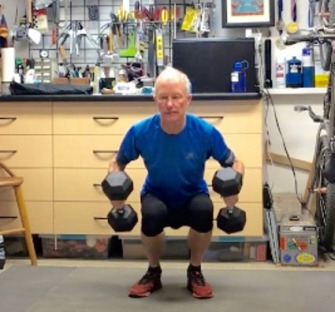
Max Strength/General Strength Exercises: As we have also written about in prior articles, Max strength/General strength programs should already being playing a central role in one’s training. This is of primary importance for the masters skier, where muscle loss is the number one performance limiter. Doing this training in a sport-specific fashion is highly productive and will yield big results once the athlete is on snow. Putting emphasis on strength training when motivation is lower is a successful approach many athletes have taken advantage of. Again, for the time spent training, strength training (including plyometerics) represents one the highest “time invested-to-results achieved” benefits for the cross country skier. Operationally, this means that if training is adversely affected by available time or motivation to do the work, strength training should be the last to be affected. Under adverse conditions in the dryland season, it is best to prioritize strength above all other training modes for the masters skier. Working with a strength professional to design an effective and sport-specific strength program (that includes progressions,) is a critically important part of any training program. Since each athlete brings different levels of strength into a training regimen, no specific recommendations can be given, but we have provided general approaches for the masters skier in our recent article “Strength Training for the Aging Endurance Athlete - Reprise.” It is most functional to utilize max strength and general strength exercises that map well onto the motions used in cross country skiing. Engaging in strength exercises that focus on motions separate from cross country skiing will have limited impact and could lead to regression. Also, in this time of pandemic, having a home gym option is very advantageous from both health perspectives (limited exposure to viruses) and a motivational perspective. It’s a lot easier to conjure up the motivation to go to your home gym than it is to gather everything you need and commute to a commercial gym that may be crowded or have limited hours of operation. Since being a successful masters athlete involves taking advantage of the limited time we have available for training, the home gym can play a big part in advancing one’s fitness. Your home gym is always open, involves no commute, is never crowded, and can be tailored to those exercises relevant to cross country skiing. A win on all fronts!
Summary
Although the current world situation is presenting challenges to the motivation of all skiers, these challenges are heightened for the masters skier who already has limited time and, often, more “life stress.” A re-assessment of one’s training plan with these challenges in mind has become essential to ensure progression. We suggest that reverting to specificity is a reliable approach to accommodating reduced levels of motivation and increased life stress Replacing racing goals with sport-specific development goals based on an assessment of individual weaknesses can go a long way to allow for steady improvements that will have significant impact once we get back to whatever “normal” ends up being.