3 reasons athletes should compete despite COVID (from a development standpoint
By Andy Newell
With races canceled left and right there are so many unknowns leading into the season ahead. Almost all of the National level races have been canceled or downgraded to smaller regional events and the competition schedule for most collegiate athletes and juniors has been thinned considerably.
I have had a few athletes reach out asking if they should abandon the season all together and essentially ‘train through’ the winter. For some collegiate athletes whose seasons are canceled they feel like they might not have a choice. Some athletes are understandably struggling with motivation and might consider taking the winter off from racing, others might consider taking the winter off from competition in order to train MORE in preparation for future season.
We will continue to tackle this topic in the weeks to come. Taking social distancing risks out of the equation for now here are my initial thoughts on why athletes should look for opportunities to race (or time-trial) despite so many cancelations.
Macrocycle periodization
If you have trained for skiing even for a short time you understand the concept of easy, medium, and hard weeks. We need the tough training weeks to stress the body with challenging workouts, and easy weeks to allow the body to absorb that training in order to get faster. In addition to this cycle of stress and recovery we also incorporate periods of volume and intensity into a training plan. As intensity builds, volume (training hours) must drop to ensure athletes absorb the hard training.
Here is a look at a basic 500hr training year graphed by month (or period = 4-week block)
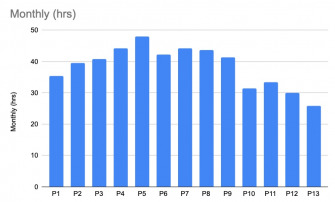
It’s interesting to look at the training year this way while simultaneously thinking about supercompensation and how an athlete is stressed in different ways throughout the year. From this graph we can see the steady increase in training hours from the beginning of the training year (May) to the peak in volume in August-September.
Why does the graph dip down in period 6? You guessed it; this is when we start to add in considerably more L4 training (October).
If I were to very unscientifically graph L3 and L4 intensity on top of these training hours, it would look like this:
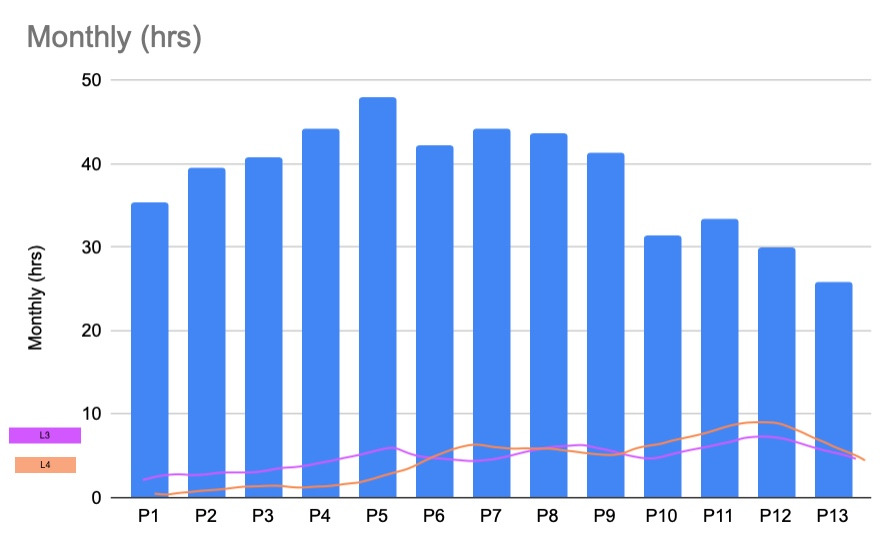
You can see how we start the training year with a focus on building L3 threshold training until the first dip in volume which is when we introduce more L4. You can see the lover volume during the bulk of the competition season (P9 – P12) is when both L3 and L4 intensity is at its highest.
I like the analogy of climbing a set of stairs. When we think about stacking training years on top of one another you can see how these periods of volume and intensity build on one another. Here is a two-year projection for an athlete increasing from 500hrs to around 560.
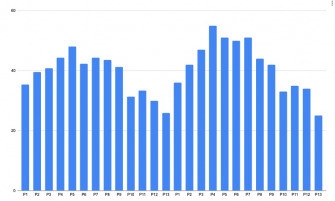
This might be an overly complicated way of showing a simple fact. Both volume and intensity are important for athletic development and in order to focus on one we need to step back the other. This is ski periodization in its most basic form. The hours of easy distance training we accomplish during the summer allow us to build mitochondria, increase efficiency, and improve specific strength making our intensity periods a higher quality. Vice versa our intensity periods build Vo2Max and aerobic capacity so when we return to a volume phase our fitness is better than when started the previous year and our base phase will consist of higher quality training.
This is probably the most obvious reason I see for athletes to continue with a race season: They need months of volume and months of intensity in order to improve in the long run. Adding a bunch of volume during a period of time when skiers would normally be racing could lead to overtraining and in the end probably stunt aerobic growth rather than build it from year to year.
Refine the process
Racing is more than just putting a bib on and going hard. Racing requires a certain set of skills that include preparation, organization, getting in the right mind-set, setting goals, and accomplishing them. This is another big reason athletes should look for racing opportunities this winter even if the competitions are unofficial. We need to practice racing to refine our race preparations, even if it’s as simple as having a start time and getting there on time!
Here in Montana we are trying to organize regular test events to make sure skiers are racing on a regular basis. Even during practice time-trials we hand out bibs, go over race strategies with the athletes, incorporate race prep intervals and ski testing to help ingrain good race preparation habits.
Intervals are not racing
Mindset and preparations aside racing is the best way to build Vo2max through sustained efforts that mix L3 lots of L4. It takes a LOT of interval days to log the amount of quality on-time a skier can get from regular winter racing.
In addition to the fitness gains both strength and technique are tested in ways on the racecourse that is very hard to replicate during intervals. Athletes need to learn about pacing and how to maintain quality technique while under serious fatigue.
More thoughts on this topic to come but these are some initial ideas. I think as a ski community we need to make sure we prioritize creating safe racing environments so athletes can continue to refine their racing skills during the winter months.