
ThoRacic Mobility Self-Assessment
By Amy Pakula, Momentum PT
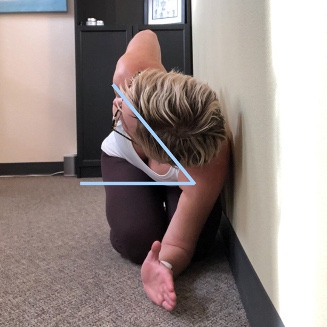
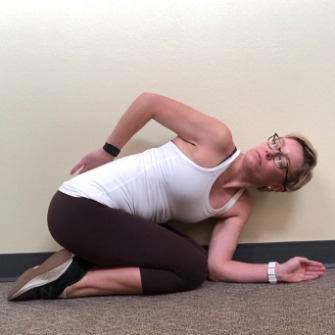
Begin by kneeling next to a wall, and go into child’s pose with the glutes on the heels. Place the forearm closest to the wall on the ground between your knees. Place the other hand behind your back. Keeping your glutes on your heels, rotate upwards towards the hand on your back.
Thoracic mobility plays a critical role in the movement efficiency and optimal power production of cross country skiers. This area of the spine plays a vital role in load transfer between the upper and lower body. It’s also a main contributor to rotational movement within the kinetic chain. Because of this, poor thoracic spine mobility can contribute to issues at the neck, shoulder, low back, and even the hip. Andy covers this in greater detail in this previous post.
While working on thoracic mobility is typically a great use of time for most athletes, it’s helpful to have baseline measurements to determine how much time to prioritize towards thoracic mobility and it allows you to measure and track progress.
Testing thoracic rotation in each direction will reveal asymmetry from one side to the other. If rotation is limited, extension (backward bending) is also typically limited in the thoracic spine.
Video demonstration above
Begin by kneeling next to a wall, and go into child’s pose with the glutes on the heels. Place the forearm closest to the wall on the ground between your knees. Place the other hand behind your back. Keeping your glutes on your heels, rotate upwards towards the hand on your back.
By kneeling next to the wall you prevent yourself from bending to the side and instead encourages pure rotation. Having your glutes resting on your heels puts the lumbar spine in some flexion, limiting motion that can come from the lumbar spine.
50 degrees of rotation should be available in each direction(shoulders relative to the ground).
You can use an app like Dartfish or Coach’s Eye to measure the angle more precisely.
In many of NTS strength routines, the first several exercises often focus on thoracic mobility. If you are looking for additional movements, I’ve compiled a playlist here.